





Pokie Machines in Australia: Games, Odds and Legality
 Available in AU
A practical guide to Australian online gambling rules, pokie features, bonus conditions and what RTP can—and cannot—tell about a game.
Table of Contents
- Online Pokies in Australia: The Legal Position
- How Pokie Machines Differ on the Casino Floor
- Free Play, Bonus Funds and the Cost of Clearing a Bonus
- What a Legal Casino Visit Looks Like in Perth
- Game Features: Networked Jackpots and Feature Buys
- RTP, Volatility and What the Odds Can—and Cannot—Say
- Demo Play and Real-Money Play Are Not Equivalent
- Pokie Apps, Payments and Withdrawal Conditions
- Recognisable Titles and New Game Features
- A Practical RTP Check Before Playing
Online Pokies in Australia: The Legal Position
Australia does not issue a licence for an operator to provide real-money online pokies to people living in the country. The legal distinction is between the business supplying the service and the person accessing it. Under the Interactive Gambling Act 2001, offering real-money pokie games online to people in Australia is an offence for the operator. The law covers online casino-style gambling services, including slots, poker and table games.
That restriction applies even when a website is run from offshore or holds a gambling licence in another country. An offshore licence does not authorise the operator to offer real-money pokie machine games to Australian residents, and it does not create an Australian regulatory framework for the service. There is no Australian online casino licence for a resident to check as proof that an offshore site is locally authorised.
The law does not make an Australian resident’s act of playing real-money pokies with an offshore operator an offence under the Interactive Gambling Act. That difference matters: the statutory prohibition described here is directed at the provider, not at the player. It does not, however, turn the service into a legal Australian product or provide the protections associated with a locally regulated online casino market. If an offshore operator refuses to pay winnings or otherwise disputes an account, an Australian player may have no effective local regulatory route to resolve the matter.
Choosing a pokie site for 2026 is easier when you can check the operator details that are available before deciding where to play. This list provides a concise reference for those details.
License: Curacao Gaming Control Board OGL/2023/174/0082 (Dama N.V.) SpinsUp lists a Curacao Gaming Control Board OGL/2023/174/0082 license held by Dama N.V.
License: Curacao – Antillephone N.V. (Versus Odds B.V.) · Min. deposit: EUR 20 Thor Casino lists a Curacao license from Antillephone N.V. (Versus Odds B.V.) and a minimum deposit of EUR 20.
License: Curacao Gaming Control Board (TechSolutions Group N.V.) Bizzo Casino lists a Curacao Gaming Control Board license, with TechSolutions Group N.V. identified.
License: Curacao Gaming Control Board OGL/2023/176/0095 (Hollycorn N.V.) GoldenCrown lists a Curacao Gaming Control Board OGL/2023/176/0095 license held by Hollycorn N.V.
License: Curacao eGaming OGL/2023/174/0082 (Dama N.V.) · Min. deposit: A$15 LevelUp Casino lists a Curacao eGaming OGL/2023/174/0082 license held by Dama N.V. Its stated minimum deposit is A$15.
License: Curacao Gaming Control Board OGL/2023/176/0095 (Hollycorn N.V.) Rollero Casino lists a Curacao Gaming Control Board OGL/2023/176/0095 license held by Hollycorn N.V.
License: Curacao eGaming OGL/2024/923/0383 (Antillephone N.V.) · Min. deposit: A$30 WinSpirit Casino lists a Curacao eGaming OGL/2024/923/0383 license from Antillephone N.V. Its stated minimum deposit is A$30.
License: Curacao eGaming (Roby Games Ltd) Roby Casino lists a Curacao eGaming license, with Roby Games Ltd identified.
License: Curacao Gaming Control Board JustCasino lists a Curacao Gaming Control Board license.
License: Curacao (operating since 2017) · Min. deposit: A$20 Uptown Pokies is described as operating since 2017 and lists a Curacao license. Its stated minimum deposit is A$20.
The same boundary applies to advertising. Online casino services that are prohibited from being supplied to people in Australia cannot be promoted here as though they were locally authorised. A foreign licence, an Australian-facing website or access through a browser does not change the underlying legal position. Nor does describing a product as an online pokie simulator or using casino-style branding establish that real-money play is permitted; the relevant question is whether the service involves real-money online gambling offered to people in Australia.
ACMA’s role and website blocking
The Australian Communications and Media Authority, known as ACMA, is the federal agency responsible for enforcing the Interactive Gambling Act 2001 and monitoring compliance with federal interactive gambling rules. Its work includes investigating prohibited services and taking enforcement action. Where a website provides an illegal interactive gambling service, or advertises one in Australia, ACMA can ask internet service providers to block access to it.
Blocking is a practical enforcement measure, not a licence check or a guarantee that every prohibited site will disappear from view. The agency’s published enforcement record reports that more than 1,455 illegal gambling and affiliate websites have been blocked since November 2019, following enforcement action. A block can interrupt access through Australian internet providers, but its existence—or the absence of one—does not change whether the underlying service is lawful for an operator to provide.

There is also a discrepancy in reported figures for services that have left the Australian market after ACMA enforcement began in 2017. One account puts the total at more than 210; another reports more than 190.
For someone assessing an online pokie machine offering, the legal question comes before the interface, title or payment method. A site can be accessible and still be prohibited from supplying real-money casino games to Australian residents. It can display a foreign licence and still lack authority under Australian law. ACMA’s blocking activity is one part of the enforcement picture; it is not a system of local licensing or a promise that every offshore service is screened before it reaches a user.
The result is a clear but asymmetric position. Operators are prohibited from supplying real-money online casino games to people in Australia, while residents are not committing an offence merely by playing with an offshore operator under this Act. That distinction should not be mistaken for approval, local oversight or a reliable means of recovering money in a dispute. No Australian online licence exists to provide those assurances for real-money pokie play.
Free-to-play material is a separate matter only insofar as it does not involve real-money gambling; the label alone cannot settle the question. A product presented as free may still lead to a real-money service, and a site’s marketing language is not a legal authorisation. The relevant boundary remains the provision of prohibited interactive gambling services to people in Australia.
Legal Status
Offering real-money online pokie games to people in Australia is an offence for the operator under the Interactive Gambling Act 2001.
How Pokie Machines Differ on the Casino Floor
Pokie machines can look similar from the outside and still use different rules for awarding prizes. The paytable sets out the value assigned to winning combinations, while the paylines determine which symbol arrangements count. Both can vary between titles, so the name or visual theme of a machine is not enough to establish how it pays.
A paytable is the machine’s reference for matching symbols and their associated prizes. It may show different outcomes for different combinations, with the value depending on the symbols and where they land. The details are specific to the title. A combination that pays on one machine cannot be assumed to pay the same amount, or under the same conditions, on another.
Paylines add another layer. Some machines use a fixed set of lines; others allow the number of active lines to vary. A payline is a defined route across the reels along which a qualifying combination can be recognised. The pattern may run across adjacent reels in a particular direction, rather than simply requiring matching symbols anywhere on the screen. The machine’s rules explain which lines count and what arrangement is needed.
That difference affects how a spin is assessed. On a fixed-line machine, the available lines remain part of the game’s configuration. Where lines can be varied, the selected setting can affect which potential combinations are eligible. The relevant details are displayed with the game rules and paytable. Comparing machines therefore means checking their individual configurations, not treating a reel layout or familiar symbols as a reliable guide.
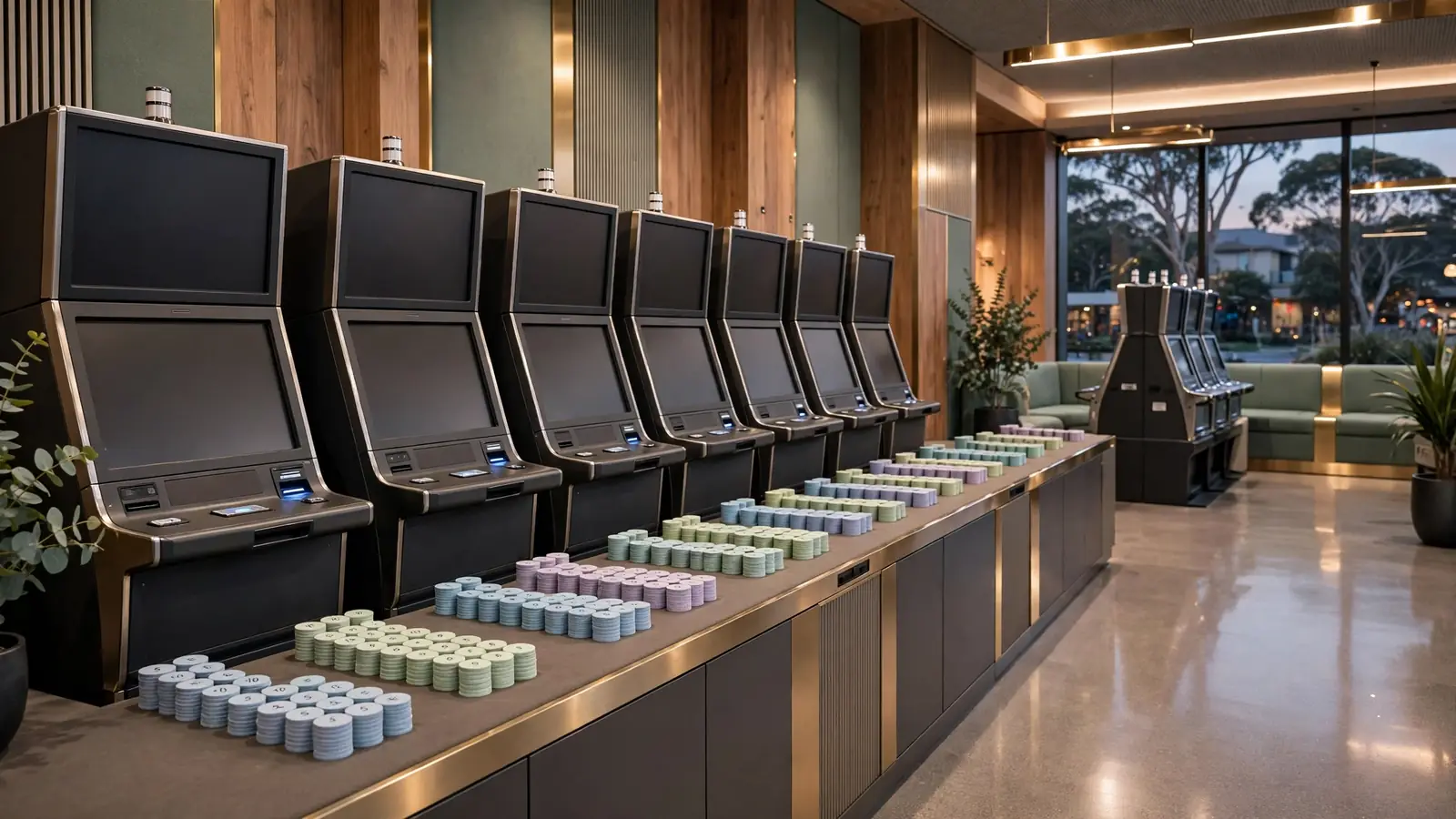
The distinction also matters when a machine shows several ways to form a winning combination. A larger number of visible routes does not, by itself, establish that a title offers better value. The paytable and the rules together describe what the machine recognises and the prize attached to an eligible result. Without reading both, the screen can show activity without making the cost or prize conditions clear.
In Victoria, electronic gaming machines are subject to requirements set by the Victorian Gambling and Casino Control Commission (VGCCC). The commission mandates that every electronic gaming machine display its RTP. This is a machine-level disclosure requirement: the figure must be shown as part of the information available on the game. It does not replace the paytable or explain the line settings, which remain relevant to understanding how that specific machine awards prizes.
The display requirements give players a consistent place to find key game information, but the information serves different purposes. The paytable describes prize outcomes; the paylines describe which arrangements can qualify; and the displayed RTP is a separate measure. None of these should be inferred from the machine’s title, cabinet design or neighbouring games. The rules shown for the particular machine are the useful reference.
Age is also part of the Victorian setting: a person must be at least 18 to play electronic gaming machines in the state. The requirement applies to the machines themselves, regardless of the title or its features.
There is no single feature that makes one pokie machine the best choice for every player. A practical comparison starts with the rules in front of the machine: whether paylines are fixed or variable, how the paytable defines winning combinations, and what information is displayed. Familiar branding may make a title recognisable; it does not make its payment rules interchangeable with another game’s.
Machine Comparison
- Check the individual paytable for matching symbols and prize values.
- Verify if paylines are fixed or variable for the specific title.
- Refer to the machine-level RTP disclosure for a long-run return measure.
- Consult the specific game rules rather than relying on branding or cabinet design.
Free Play, Bonus Funds and the Cost of Clearing a Bonus
Free play and a deposit bonus are different offers, even when both are presented beside the same pokie. Free play in demo mode does not require a stake of real money. A bonus, by contrast, is promotional value attached to an account or deposit and may come with conditions that must be met before any winnings can be withdrawn. The word “free” does not make those conditions disappear.
No-cost play is practice, not a forecast
A free pokie machine in demo mode can show how its reels, buttons and features work without putting money at risk. That can help with basic familiarity: the software displays the game’s rules and the sequence of play, while the theme is presentation rather than a measure of value. Demo results do not predict real-money outcomes. A favourable practice session says nothing about what a later paid session will return.
The distinction matters because virtual credits are not a cash balance. They cannot be treated as funds available to withdraw, and a run of demo wins does not create an expectation that the same pattern will appear when real money is staked. Practice play is a way to inspect a game, not a method for testing a strategy that can reliably produce a return.

Searches for a pokie machine to play for free can also point to physical machines for sale or software that imitates a casino game. Those are separate products. Buying a machine is not the same as playing a demo, and game software does not turn virtual results into a cashable balance. The relevant distinction is whether money is being wagered and whether the offer attaches conditions to promotional funds.
A bonus is a turnover obligation
A deposit bonus can look like additional balance, but the headline amount is not automatically withdrawable. The wagering requirement sets the amount of betting that must occur before cashout is permitted. A specialist review gives a specific illustration: a $100 bonus with a 30x requirement calls for $3,000 in bets before cashout. That is a calculation for that stated example, not a general rule for bonuses.
The arithmetic is straightforward: the bonus amount is multiplied by the wagering multiple. The resulting figure is turnover, not a promise that the player will lose exactly that amount, nor a guarantee that the bonus will survive long enough to complete the requirement. Each bet uses funds while the balance is exposed to game outcomes. The amount required to wager can therefore be much larger than the promotional credit that triggered the calculation. “Bonus value” and “cash available” are not interchangeable accounting categories.
The terms determine what counts toward turnover and what happens when the requirement is not completed. Those details affect the usable value of an offer; the promotional figure alone does not. A bonus with a large nominal amount can still have little practical value if its conditions make the required play difficult to complete.
Bonus Turnover Calculation
Take the promotional credit provided, for example, $100.
Identify the multiplier attached to the bonus, such as 30x.
Multiply the bonus amount by the requirement ($100 × 30) to determine the required bet amount, which is $3,000.
Free spins can still create restricted funds
Free spins are not necessarily equivalent to unrestricted cash. Winnings generated from them are bonus funds, subject to wagering requirements and cashout limits. That distinction applies even if the spins themselves cost nothing: a resulting balance may remain conditional until the relevant terms have been satisfied.
The sensible comparison is therefore between the offer and the obligation attached to it. No-cost demo play has no real-money stake, but it also offers no cashable result. A deposit bonus can add promotional funds, but its withdrawal value depends on the terms and on completing the required turnover. Neither format makes a pokie machine strategy a dependable route to profit. The demo supplies practice; the bonus supplies conditions. Neither supplies certainty.
What a Legal Casino Visit Looks Like in Perth
Crown Perth is the only legal land-based casino in Perth. Western Australia has no legal online casino market, so a visit to Crown Perth means a physical venue rather than a locally licensed online alternative. The casino has more than 2,500 gaming machines, giving the floor a substantial range of titles and machine setups. That count does not, by itself, tell a visitor which game offers the best return.
Most machines on the floor operate within an RTP range of 87% to 92%. RTP is a long-run measure, not a forecast of what a particular machine will return during one visit. Crown Perth does not publish an RTP list for each individual machine, so the range cannot be used to identify a specific machine’s setting or rank the floor from highest to lowest. A claim about the “highest-paying” pokie at the venue would need machine-level information that is not publicly listed.
What is displayed on the machine
Western Australian rules require every legal pokie to show its rules, paylines and prize table. Those details are the practical starting point for comparing casino pokie machines. The rules explain how the game operates; the paylines show which symbol combinations can form winning lines; and the prize table sets out the awards attached to those combinations.

The information is more useful than a title or cabinet appearance when assessing what a machine offers. Two games can look similar while using different paytables or paylines. A large prize displayed in a game’s presentation is not enough to establish how often it can be reached or what the machine returns over time. The displayed material describes the game’s conditions, not a likely result for the next session.
A pokie machine payout percentage also needs to be read at the correct level. The 87% to 92% range describes most machines on Crown Perth’s floor, not every individual machine as a separately confirmed figure. Because there is no published machine-by-machine list, a visitor cannot reliably select a cabinet based on a precise RTP comparison using venue-wide information alone.
Comparing the cost and the information
A casino-floor comparison can still be made by reading the machine’s displayed terms before play. The prize table gives the awards associated with combinations, while the payline information shows which combinations count. These details help distinguish one casino pokie machine from another without treating a prominent jackpot or a short run of results as evidence of a better payout percentage.
A “best Australian pokie machine” is therefore not a single identifiable choice on the basis of Crown Perth’s public RTP range. The venue provides a broad selection, but its published information does not establish a machine-by-machine ranking. The distinction matters: a range can describe the floor while leaving the precise setting for a particular cabinet unknown.
For a visit, the useful comparison is the information actually available on the machine, set against the amount intended for play. The rules, paylines and prize table are displayed requirements; the venue-wide RTP range is context rather than a promise. Neither a pokie machine simulator nor a brief observation of a machine can turn that context into a dependable prediction of real play. The machine’s displayed terms remain the clearest basis for understanding its structure, while the result of any individual session remains uncertain.

Game Features: Networked Jackpots and Feature Buys
Networked progressive jackpots and feature buys change different parts of a pokie’s play. A networked jackpot links a prize across machines or venues; a feature buy lets a player pay extra to enter a bonus round immediately. Neither changes the basic point that a displayed feature is a game mechanic, not a forecast of what a session will return.
Networked progressive jackpots
Titles such as Lightning Link, Dragon Link and Cash Express can be connected across multiple machines or casinos. This shared network builds a progressive jackpot, so the prize is not confined to the machine on which a winning combination eventually appears. The defining feature is the shared pool: the game’s jackpot is linked across participating machines or venues.
That distinction matters when comparing a networked title with a game whose prize is limited to one machine. The network explains how a jackpot can grow across a wider group of games; it does not establish how often it will be won, how much any individual session will return, or whether a particular player is likely to reach it. A large displayed prize describes the accumulated jackpot, not a dependable outcome.
The names identify examples of networked games, not a guarantee that every installation uses identical settings or offers the same prize conditions. The relevant information is the one displayed for the specific machine and game being played.
Paying to trigger a feature
Feature-buy slots offer a different choice. Rather than waiting for the bonus feature to occur during ordinary play, the player pays a premium to trigger it directly. The bonus is often a free-spins round, but the defining cost is the additional charge attached to entering the feature.
A specialist review has described the premium for this mechanic as often ranging from 50 to 100 times the base bet. That is a reported range, not a universal setting for every title or venue. Since the multiplier is applied to the base bet, the entry price rises with the stake: increasing the base bet also increases the cost of buying the feature. The displayed rules for the particular game determine the actual terms.
Paying a premium to trigger a bonus feature secures access to the round but does not guarantee a prize or make the round profitable.
The purchase changes the route into the bonus, not the financial certainty of its result. Paying the entry cost secures access to the feature; it does not secure a particular prize or make the round profitable. The cost therefore belongs in the session’s total spend, separate from any later outcome. A feature buy can compress the wait for a bonus into a single paid decision, but the premium remains a real cost whether the bonus produces a return or not.
RTP, Volatility and What the Odds Can—and Cannot—Say
RTP is a long-run measure: it describes the share of all money wagered on a pokie that is returned across a very large number of spins. It is not a forecast for one session, a cashout target or a promise that a particular stake will come back. A high RTP does not ensure short-term wins; individual sessions can vary widely.
A specialist review reports an RTP of 96.5% for Gates of Olympus and 96.48% for Sweet Bonanza. Those figures identify the versions covered by that review, not every version available at every casino. Some providers allow operators to select from different RTP settings for the same game, so the specific version offered matters. A title name alone is not enough to establish which figure applies.
RTP and volatility describe different things. RTP concerns long-run returns across play; volatility concerns how those returns are distributed. Low-volatility pokies tend to pay smaller amounts more often. High-volatility pokies pay less frequently, but can produce larger wins. Neither label makes a result predictable, and neither changes the independence of each spin.
Every spin is separate from the one before it. A run of losses does not make a win more likely on the next spin, and recent wins do not reduce the chance of another. Past results have no influence on future outcomes. That is why a session can finish far above or below the long-run RTP expectation without contradicting it.
For anyone comparing what might be the best pokie to play, a higher stated RTP is only one input. It does not establish the best chance of winning during a short session, and it cannot identify a best pokie machine to win on. Volatility affects the pattern of results, while the exact game version determines which RTP setting is in play. The word “odds” can therefore suggest more certainty than the figure provides.
Before play, the practical checks are the game’s displayed RTP and the specific version running at the selected casino. A loss limit should be set in advance and treated as a firm spending boundary, not adjusted because a session is running poorly. RTP is useful for comparing long-run game settings; it is not a short-term guarantee or a reason to raise that boundary.
Demo Play and Real-Money Play Are Not Equivalent
A pokie machine demo can show a game’s layout, symbols, controls and bonus presentation without putting money at stake. That makes it useful for learning how the screen works. It does not establish what a real-money session will return, how soon a feature will appear, or whether a particular run of spins is likely to repeat.
Demo results are not indicative of real-money outcomes. A run of wins in practice mode is not evidence that the same game will produce similar results when money is wagered. Nor does a run of losses in a demo establish that a win is due next. Each spin is generated by a random number generator and is independent of the spin before it. Previous results do not alter the next outcome.
Do
- Use demo mode to learn the game layout and controls.
- Treat practice sessions as interface tests.
- Set a firm loss limit before starting real-money play.
Don’t
- Use demo results to predict real-money outcomes.
- Assume a run of wins or losses in demo mode influences future spins.
- Adjust loss limits based on poor session performance.
The distinction matters because a demo has no financial consequence for its player. In real-money play, each wager changes the balance available to the player, while the visible game may look much the same. Familiarity with the buttons can reduce mistakes in navigating the interface; it cannot remove the uncertainty of the result. A practice session is therefore an interface test, not a forecast.
A real pokie machine may also appear in an app or browser in a demonstration mode. The format does not change what the practice results mean. Whether played on a phone or a larger screen, simulated outcomes provide no basis for estimating the returns of a money wager. A displayed balance in a demo is not a cash balance, and a simulated win is not a payout.
The same limit applies when comparing a demo with a physical machine. Similar graphics or game names do not make outcomes interchangeable. The relevant point is not whether the presentation feels realistic; it is that practice results cannot predict a future spin involving money.
A sensible use of demo play is narrow: check the controls and understand the sequence of play, then stop treating the session as evidence about likely results. Before any real-money gambling, set a loss limit and regard it as a fixed cost, not a target that must be recovered. If the limit is reached, extending play does not improve the odds. The demo can explain how a pokie operates on screen; it cannot price the risk of a real-money session.
Pokie Apps, Payments and Withdrawal Conditions
A pokie app is an access method, not a separate form of gambling or a change to the legal position. In Australia, operators cannot lawfully provide real-money online pokies to people in the country. An app offered by an offshore casino does not acquire Australian approval merely because it can be installed or opened on a phone. The same applies to a mobile website or a service connected through a pokie machine API: the delivery method does not alter the status of the underlying service.
Payment options require the same distinction between what an operator advertises and what is lawful. A specialist review of operators catering to Australians reports deposits by Visa, Mastercard and bank transfer, with Bitcoin and Ethereum increasingly listed. That describes reported payment methods, not an endorsement or a guarantee that every operator accepts them. Credit card payments must not be used for online gambling services. A payment logo on a site also says nothing about the security of funds or the ability to recover them.
The cost of accessing a game is not limited to a deposit. A deposit becomes money exposed to play; a withdrawal request, by contrast, may not be processed immediately. Withdrawals can remain pending for 24–72 hours, and some casinos may use that interval to encourage a player to reverse the request and return the funds to a balance available for gambling. Reversing a withdrawal changes the amount still due to be paid out. It is a financial decision, not a routine administrative step.
Payment and Withdrawal Check
- Confirm the operator’s withdrawal processing time (e.g., 24–72 hours).
- Verify if pending withdrawal requests can be cancelled or reversed.
- Check the terms for any conditions attached to the withdrawal of winnings.
- Ensure credit cards are not being used for online gambling services.
An app can make account balances and payment controls easier to reach, but it does not make a pending withdrawal final or protected. Before funds are deposited, the relevant terms include how withdrawal requests are handled and whether a pending request can be cancelled. If an offshore operator withholds winnings, an Australian player may have no effective legal recourse. That exposure is separate from whether the account displayed a balance or a withdrawal confirmation.
There is no single “best” pokie app that can be identified from an interface or payment menu alone. Access, payment processing and withdrawal conditions are separate parts of the arrangement; none establishes that real-money online play is lawful in Australia. A jackpot shown in an app is also a game feature, not evidence that winnings can be withdrawn without difficulty.
Recognisable Titles and New Game Features
A familiar name is useful for identification, but it does not establish what a game does. The clearest feature-based examples are Lightning Link, Dragon Link and Cash Express: these games can be linked across multiple machines or casinos, contributing to a progressive jackpot. The relevant distinction is the networked jackpot, not whether a title is described as new.
That distinction matters when comparing pokie machine names. A title may be recognisable without its name revealing how its prizes work, what features it includes or whether it has recently been released. Claims about a new pokie machine or new pokie machine games therefore need to be tied to a specific, stated feature rather than the word “new” alone. A release label is not a description of the game’s mechanics.
Other names, including Chilli, Buffalo, Queen of your own Nile, Book of Dead, Immortal Romance, Mega Joker by NetEnt and Mega Moolah, can be identified as titles. Their names alone do not establish a particular jackpot structure, bonus feature, volatility level or RTP. Those details should not be inferred from a title or from a resemblance to another game.
For a practical comparison, separate three things: the title, the feature being claimed and the evidence for that claim. For example, “networked progressive jackpot” is a concrete feature description for Lightning Link, Dragon Link and Cash Express. A bare statement that a game is popular, familiar or new supplies no equivalent information about its mechanics.
This keeps a list of recognisable titles from becoming a list of unsupported promises. Where a specific feature is known, it can be stated plainly. Where only the name is known, the name is all that can responsibly be said. Familiarity may help identify a pokie; it does not determine its prizes or outcomes.
A Practical RTP Check Before Playing
A useful check is not whether a pokie advertises a high RTP, but whether the figure applies to the exact version available. RTP measures the share of all stakes returned across a very large number of spins. It is a long-run calculation, not a forecast for an individual session. A high figure does not ensure a short-term win; results can vary widely.
Before play, confirm the game’s RTP in the information shown by the casino or in the game rules. Some providers make several RTP settings available for the same title, so a figure quoted for one version may not match the version on offer. If the applicable setting is unclear, the advertised number is not enough to make a sound comparison.
Then set a loss limit before starting and treat it as a fixed cost, not a target to recover. RTP does not change the outcome of the next spin, and previous results have no influence on it. Once the limit is reached, continuing adds exposure without improving the underlying odds.
These are practical pokie machine tips in accounting terms: verify the version, interpret RTP over the correct time scale, and define the amount at risk in advance. The calculation can describe a game’s long-run return; it cannot promise what a session will return.
Can I play pokies for free before betting real money?
Yes, if the game is genuinely free-to-play and does not involve real-money gambling. A “free” label alone does not establish that, especially if the game leads to a real-money service.
How much money do I need to play pokies?
At Crown Perth, minimum bets typically range from $0.20 to $2.00 per spin, depending on the machine.
What law governs online gambling in Australia?
The Interactive Gambling Act 2001 governs online gambling services. It makes it an offence for operators to offer real-money online pokies to people in Australia, although a resident does not commit an offence under this Act merely by playing with an offshore operator.
Is there a strategy to win at pokies?
No strategy can influence the outcome: each spin is random and independent of previous spins. Choosing a lower-volatility game may mean smaller wins occur more often, but it does not guarantee a win.
Written by the editors at Oscarspin Casino.