






Best-paying online pokies in Australia: payout claims
 Available in AU
Legal limits, game credits, bonus terms and Bitcoin transactions all affect how offshore casino payout claims should be understood.

Table of Contents
- The Legal and Commercial Limits Behind Offshore Casino Claims
- What “Paying” Means for a Machine’s Game Credits
- Free Play and Real-Money Play Are Different Comparisons
- Why “Best Paying” Is Not a Verified Payout Ranking
- Bonus Terms That Change the Arithmetic
- Bitcoin Deposits and Withdrawals: Where Errors Occur
- From Fiat Currency to a Bitcoin Casino Account
- Verification Before a First Withdrawal
- Bitcoin Costs and Processing Claims in Context
- When a Bitcoin Withdrawal Is Delayed or Disputed
The Legal and Commercial Limits Behind Offshore Casino Claims
A claim that an online casino is among the best-paying options in Australia sits within a market where the legal distinction matters more than the wording of an advertisement. The Interactive Gambling Act 2001 bars operators from providing real-money online casino games to people physically located in Australia. Pokies, poker and table games fall within that prohibition when offered online as interactive gambling services.
That restriction concerns the operator’s provision of the service. It does not turn a foreign licence into an Australian one, nor does it mean that a locally authorised online casino can offer real-money pokies to Australian residents. The legal position is not a choice between a locally licensed casino and an offshore casino with equivalent local standing: the services discussed here are not locally licensed real-money casino products.
The operators covered by this page hold licences issued offshore, primarily by Curacao eGaming or the Anjouan Gaming Authority. Such a licence describes the jurisdiction in which an operator claims regulatory oversight; it does not establish permission to provide real-money online casino games in Australia. A licence badge can therefore be relevant to identifying an operator’s stated regulatory framework without settling whether its service is lawful for the Australian market. Those are separate questions, and treating them as one is a convenient shortcut for the operator, not a legal analysis.
The resulting consumer-protection position is also different from the one that applies to services covered by Australian consumer law. Australian consumer protection laws do not apply to the offshore operators discussed here. That means a player cannot assume that Australian protections or remedies will govern a dispute with such an operator simply because the player is in Australia or the site accepts Australian customers. A foreign licence does not fill that gap with Australian rights.
The law also restricts the provision and promotion of online casino services to Australian audiences. People under 18 must not gamble for real money. For anyone reviewing material about offshore services, the distinction between describing a claim and endorsing the service is material.

The commercial context should be visible as well. This page is affiliate material and may include sponsored links. That disclosure identifies a possible financial relationship; it does not validate an operator, establish the accuracy of a payment claim or alter the legal position. A sponsored placement is not evidence of local authorisation, and a payment-related statement remains a claim to assess rather than a guarantee. Commercial visibility is useful, but it is not a substitute for consumer protection.
The phrase “best-paying” can make a commercial comparison sound like a settled finding. In this market, that wording should not be read as proof that an operator is locally approved, that an advertised service is lawful to provide in Australia, or that Australian consumer protections apply. Nor does the presence of a licence from an offshore authority answer those questions. The heading of a ranking, the placement of a link and a licence label each communicate something different; none should be treated as a complete account of the legal position.
The practical limit is straightforward: the operators considered here are offshore services, and the legal protections available for dealings with them are not the same as those attached to Australian-regulated consumer services. A commercial comparison can describe the claims being made, but it cannot convert those claims into local approval. That distinction sets the boundary for reading every payment or performance statement on this page.
What “Paying” Means for a Machine’s Game Credits
A Bitcoin pokie is a digital slot machine that accepts Bitcoin as a payment method. That description identifies how the game is funded; it does not establish what a spin costs in Bitcoin or how much a machine returns. Those are separate questions, and the word “paying” can blur them.
The unit displayed during play is a game credit. A specialist affiliate review describes credits as specific to each game, with their Bitcoin value depending on the game and the current BTC price. This is a source-specific description, not a fixed conversion rule that can be assumed to apply across every machine or operator.
A game credit is a source-specific unit; its Bitcoin value depends on the specific game’s credit arrangement and the current BTC price.
That distinction matters because a credit is not itself a universal Bitcoin unit. The amount represented by a displayed credit depends on the game’s own credit arrangement. A credit count on one machine therefore cannot be treated as directly equivalent to the same count on another. Without knowing the particular game’s conversion, the number of credits alone does not state the Bitcoin amount at stake.
The BTC price adds another moving part to that relationship. A game’s credit arrangement and the current Bitcoin price both affect the Bitcoin value attached to its credits. The displayed count may remain legible as a game-specific unit, while its value in Bitcoin is tied to the price used for conversion. A change in BTC price can therefore change that comparison even when the credit count has not changed.
This makes “cost per credit” an incomplete description unless the game and the relevant Bitcoin conversion are also clear. Similarly, comparing credit counts between games does not provide a like-for-like measure of value. The figures belong to each game’s own setup; treating them as though every machine shares one common credit scale would collapse two different quantities into one.
The distinction can be expressed without assigning a universal rate: the game determines what its credit represents, while the BTC price affects the Bitcoin value associated with that credit. Both pieces are needed to interpret the unit. A statement about credits without the game’s terms leaves the conversion unspecified; a statement about Bitcoin value without its price context can become out of date.

The word “paying” can also refer to a different measurement: an outcome or return from play. That is not what a credit conversion tells anyone. A credit’s Bitcoin value describes the unit used within a particular game, not the amount a player will receive from a session. Nor does a larger Bitcoin value per credit, by itself, establish that a machine returns more. It only changes the monetary scale attached to that unit.
For a meaningful comparison of amounts, the relevant details would have to be read together: which game defines the credit, what Bitcoin value is attached to it, and which BTC price informs that value. If any of those details is unclear, a credit count is not enough to calculate the corresponding Bitcoin amount. Describing one machine as the best-paying option on the basis of credit denominations would confuse a unit of play with a return measure.
The practical accounting point is narrow. Bitcoin identifies the payment currency; game credits identify the unit used inside a particular machine. The conversion between them is not presented as a common value across games, and the Bitcoin price can affect the resulting comparison. Credit denominations should therefore be treated as game-specific figures, not as a ranking of machines or a promise about what play will return.
Free Play and Real-Money Play Are Different Comparisons
Online pokies may be offered in free-play or real-money modes. Those labels describe different conditions, so a statement about one mode cannot automatically be treated as a statement about the other. The distinction matters whenever claims about results are presented without making clear which mode they concern.
Attention: Results from free-play mode are not equivalent to real-money play, and claims about one should not be automatically applied to the other.
Free play is not a real-money result. Real-money play is not a free-play result. Treating them as interchangeable removes a material part of the comparison: whether money is involved. A claim that leaves the mode unstated therefore has an incomplete basis. It may refer to one setting, the other, or both, and those possibilities are not equivalent.
This is a matter of scope rather than terminology. A description of free play should be read as applying to free play unless it expressly establishes otherwise. The same applies to a description of real-money play. Moving from one category to the other without evidence changes the conditions being discussed. A favourable statement about free play does not, by itself, establish anything about real-money play; nor does a statement about real-money play establish what happens in free play.
The distinction also affects how comparisons are framed. Two claims cannot be compared responsibly if one concerns free play and the other concerns real-money play but the difference is ignored. Before comparing their wording, the mode needs to be identified. Otherwise, the comparison combines unlike conditions and can make a general claim appear more definite than it is.

A headline or short description may omit that detail. In that case, its apparent breadth should not be mistaken for proof that it covers both modes. The claim should be interpreted no more widely than its stated conditions allow. If the mode is not identified, the scope remains unclear; supplying a missing condition by assumption would not resolve that uncertainty.
In Australia, the legal setting adds a separate limit. The Interactive Gambling Act 2001 prohibits operators from providing real-money online casino games, including pokies, to people physically located in Australia. The distinction between free and real-money play does not remove that restriction on operators. A description of two modes is therefore not an invitation or recommendation to use a real-money service from Australia.
For an accurate reading, claims about play need to be kept within their stated mode. Free-play material should not be used as a substitute for information about real-money conditions, and real-money claims should not be presented as though they describe free play. The categories can be named together, but that does not make the conditions identical.
Mode Distinction
- Free play and real-money play are separate subjects for comparison.
- The mode determines the conditions to which a performance claim refers.
- Real-money online casino games are prohibited for operators providing services to people in Australia.
This boundary is particularly important when a statement uses broad language about how a game performs. Without a clear mode, the reader cannot tell which conditions the statement covers. Repeating the statement in broader terms does not fix the problem; it only carries the ambiguity forward. The sound approach is to preserve the distinction and avoid transferring a claim from one mode to another.
Free play and real-money play are thus separate subjects for comparison. The mode is not a minor qualifier that can be dropped for convenience: it determines the conditions to which a claim refers. In Australia, real-money casino play also sits within a legal prohibition on operators providing that service to people in the country. Any account of these modes needs to preserve both distinctions, rather than allowing a description of one to stand in for the other.
Why “Best Paying” Is Not a Verified Payout Ranking
When looking for online pokies in Australia, payout potential is only one part of the decision; the operator’s available licensing and deposit information can also help set expectations. Use this list as a starting point and check the terms that apply to Australian players before depositing.
License: Curacao Gaming Control Board OGL/2023/174/0082 (Dama N.V.) SpinsUp is listed with a Curacao Gaming Control Board licence, OGL/2023/174/0082, held by Dama N.V.
License: Curacao – Antillephone N.V. (Versus Odds B.V.) · Min. deposit: EUR 20 Thor Casino is listed with a Curacao licence through Antillephone N.V. (Versus Odds B.V.). Its minimum deposit is EUR 20.
License: Curacao Gaming Control Board (TechSolutions Group N.V.) Bizzo Casino is listed with a Curacao Gaming Control Board licence held by TechSolutions Group N.V.
License: Curacao Gaming Control Board OGL/2023/176/0095 (Hollycorn N.V.) GoldenCrown is listed with a Curacao Gaming Control Board licence, OGL/2023/176/0095, held by Hollycorn N.V.
License: Curacao eGaming OGL/2023/174/0082 (Dama N.V.) · Min. deposit: A$15 LevelUp Casino is listed with a Curacao eGaming licence, OGL/2023/174/0082, held by Dama N.V. Its minimum deposit is A$15.
License: Curacao Gaming Control Board OGL/2023/176/0095 (Hollycorn N.V.) Rollero Casino is listed with a Curacao Gaming Control Board licence, OGL/2023/176/0095, held by Hollycorn N.V.
License: Curacao eGaming OGL/2024/923/0383 (Antillephone N.V.) · Min. deposit: A$30 WinSpirit Casino is listed with a Curacao eGaming licence, OGL/2024/923/0383, through Antillephone N.V. Its minimum deposit is A$30.
License: Curacao eGaming (Roby Games Ltd) Roby Casino is listed with a Curacao eGaming licence held by Roby Games Ltd.
License: Curacao Gaming Control Board JustCasino is listed with a Curacao Gaming Control Board licence.
License: Curacao (operating since 2017) · Min. deposit: A$20 Uptown Pokies is listed as operating since 2017 under a Curacao licence. Its minimum deposit is A$20.
“Best paying” sounds like a measurable category, but the phrase does not identify what has been measured. It could refer to how often a game returns a win, the size of a particular win, or the share of stakes returned across a defined period. Those are different measures. A claim that does not specify which one it means cannot support a useful comparison.
A defensible ranking would need to identify the games assessed, the payout measure used and the conditions under which the comparison was made. It would also need evidence that can be checked independently, rather than a label supplied by a promoter. Without those elements, placing one game above another gives an impression of precision without showing the calculation.
A large win is not proof that a game pays more overall. It is one outcome. Nor does a run of frequent wins establish a higher return across broader play. Individual results can vary, so a personal session cannot stand in for a consistent comparison. A ranking based on anecdotes may describe what someone experienced, but it does not establish which game has the stronger payout profile.
The word “best” adds another problem: it implies a standard. If the standard is not stated, the ranking may simply reflect the publisher’s selection or commercial arrangement. A prominent position on a page is not itself evidence of a higher return. Where a claim is attached to a particular game, the supporting method matters more than the adjective.

The distinction between free play and real-money play also matters when interpreting any stated comparison. Players can choose either mode for online pokies, but a claim should make clear which mode it concerns. Otherwise, the reader cannot tell what the result is meant to describe. That point does not establish that one mode pays more; it establishes that the conditions behind a claim need to be visible before the claim can be assessed.
A useful payout statement would therefore need a defined measure, identified games, consistent comparison conditions and evidence that permits the calculation to be examined. If those details are absent, the ranking is unverified. It may still be advertising language, but it is not a reliable basis for deciding that one game pays better than another.
This page contains affiliate material and may include sponsored links. Commercial placement can affect which material is presented prominently; it does not verify a payout claim. The distinction is straightforward: a ranking is evidence only when its method and underlying results can be checked, not because it appears in a list or carries a confident label.
Bonus Terms That Change the Arithmetic
A bonus headline does not show how much of a qualifying wager counts towards its conditions. The relevant figure is the game’s wagering contribution: the percentage of play credited to the bonus requirement. If the terms are unclear about that percentage, the value of the offer cannot be calculated from its headline alone.
Examples of wagering contributions
Table games may contribute 0%, while pokies may contribute 100%. Some high-RTP slots may be subject to a 50% cap, meaning only half the wager is credited toward the bonus requirement.
Contributions can differ sharply by game category. Table games may contribute 0%, while pokies may contribute 100%. Some high-RTP slots may instead be subject to a 50% cap. Those rates are not interchangeable: a wager on a game contributing nothing does not advance the bonus requirement, while a qualifying pokies wager may count in full. Where a cap applies, the credited amount is reduced accordingly.
That distinction matters more than a game’s reputation for paying. A player comparing which online pokie or slot game appears to return more money is considering a different question from whether play counts towards a bonus. A game can be relevant to bonus progress under one set of terms and treated differently under another. The label “pokies” alone does not establish the contribution rate.
A useful calculation begins with the game category and the contribution percentage stated in the offer terms. The amount of qualifying play credited is the wager multiplied by that percentage. At 0%, the credited amount is zero; at 100%, it equals the wager; at a 50% cap, only half the wager is credited. The bonus balance and the qualifying contribution are therefore separate figures. Treating them as the same number makes the apparent progress unreliable.
The maximum-bet condition is a separate control. Bonus terms may set a maximum wager while bonus play is active. Exceeding that limit can void the bonus. A wager may therefore count towards progress under its game contribution rate and still breach a separate condition. The arithmetic is not a defence to the breach; both rules apply at once.

Disputes can follow when the terms do not clearly identify which games receive which contribution, or when a cap is not apparent in the summary of an offer. Different rates for table games and pokies make a general claim that “play counts” insufficient for calculating progress. The operative detail is the rate attached to the game category, alongside the maximum-bet rule.
For any comparison of bonus value, the calculation must use the stated contribution for the chosen game category and account for the maximum wager condition. If either term is ambiguous, the resulting estimate is not dependable. A headline bonus amount, by itself, supplies neither the contribution rate nor confirmation that every wager complies with the conditions.
Bitcoin Deposits and Withdrawals: Where Errors Occur
Bitcoin transfers depend on the destination address being entered correctly. In an offshore casino payment flow, a deposit is sent from a personal wallet to the account address displayed by the operator. A withdrawal request works in the opposite direction: the player’s wallet address is entered in the casino’s withdrawal form. These are separate transactions, and an address suitable for one should not be assumed suitable for the other.
The key control is the address itself. A single incorrect character can direct funds somewhere other than the intended destination. Blockchain transactions are irreversible, so cryptocurrency sent to an incorrect address is generally unrecoverable. That makes copying and checking the destination materially different from correcting an ordinary banking detail after submission.
Irreversible Transactions
Blockchain transactions are irreversible; funds sent to an incorrect destination address are generally unrecoverable.
A deposit may also reach an address without appearing in the casino account as expected. Known causes include reusing an address, sending less than the amount required by the operator, or the operator detecting the deposit late. These causes have different implications: an underpayment concerns the amount sent, while delayed detection concerns when the operator records it. Neither should be treated as proof that the transaction was sent to the right account or that the account balance will update at a particular time.
Address reuse creates an additional source of ambiguity. If an address has been used before, a later transfer may not be matched to the intended account or deposit record. The operator’s displayed address and the address used in the wallet therefore need to correspond to the same transaction. A mismatch is not resolved by assuming that the payment system will identify the intended recipient from the surrounding account details.
Withdrawal requests have their own input risk. The wallet address pasted into the form must be the address intended to receive the funds. A typo or an address copied from the wrong wallet can result in a transfer that cannot be reversed after it is sent. The withdrawal form records the submitted destination; it does not make an incorrect blockchain address recoverable.

A balance discrepancy can therefore arise at several points: the destination entered, the amount transferred, address reuse, or the operator’s recognition of the deposit. Those distinctions matter when assessing what happened. Offshore operators are not covered by Australian consumer protection laws, so an unresolved account-crediting problem does not carry the same local protections as a dispute with an Australian service. The transaction record and the operator’s account record may also differ; neither should be mistaken for a guarantee that funds can be recovered.
From Fiat Currency to a Bitcoin Casino Account
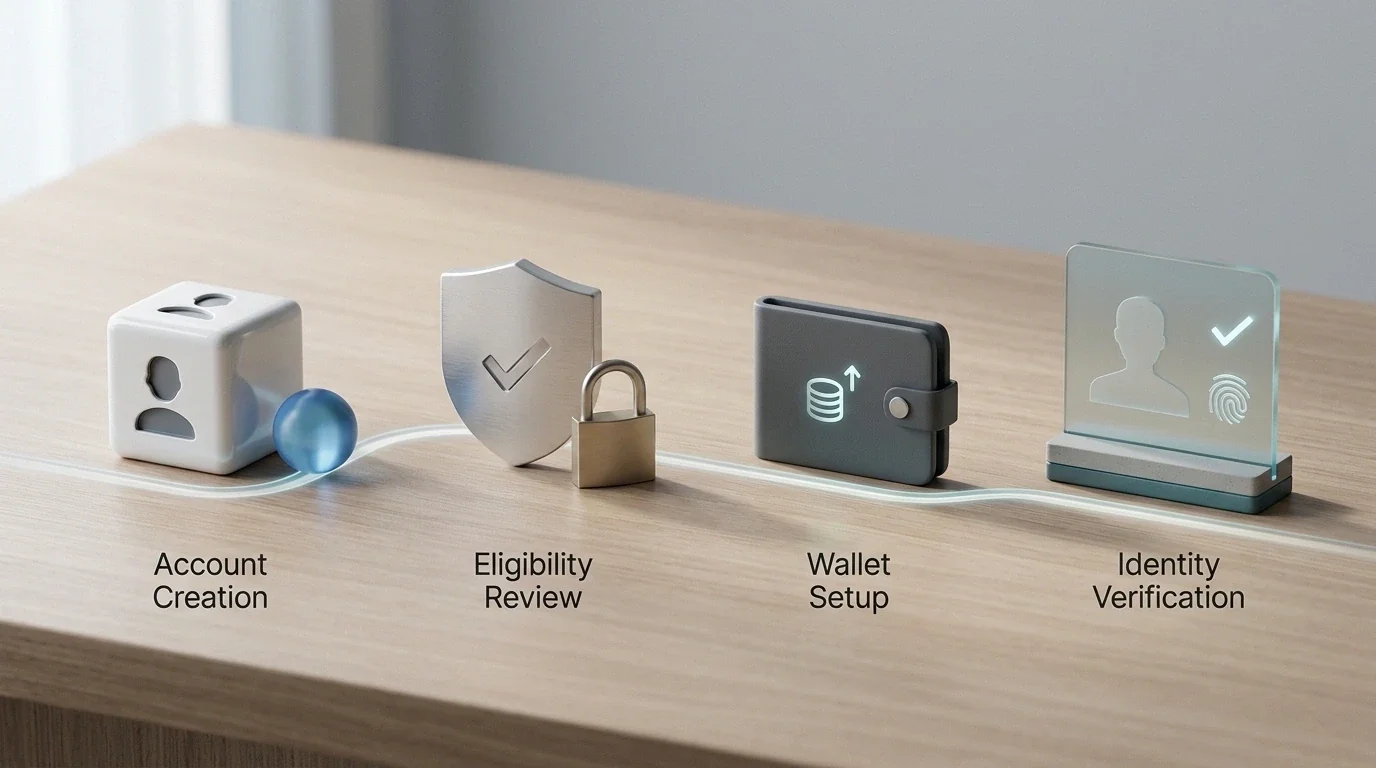
A typical account setup described for offshore Bitcoin casinos has three parts: obtaining Bitcoin, registering an account and transferring Bitcoin from a personal wallet to an address supplied by the operator. That sequence describes how the payment route is presented; it is not a recommendation to use it.
Bitcoin can be purchased with fiat currency through a cryptocurrency exchange. The exchange’s own account setup may request basic information and require a password. The amount of Bitcoin acquired is then held in a wallet before any transfer is considered. Exchange access, account registration and access to an offshore gambling service are separate arrangements, each with its own terms.
The next step in the described process is casino account registration. This generally involves submitting basic details and setting a password. Registration does not establish that the operator is authorised to provide real-money pokies to people in Australia. Under the Interactive Gambling Act 2001, operators are prohibited from providing real-money online casino games to people physically located in Australia. A foreign licence does not change that position or bring the operator within Australian consumer protection laws.
Account Setup Process
Purchase Bitcoin with fiat currency through a cryptocurrency exchange and hold it in a personal wallet.
Create a casino account by submitting basic details and setting a password.
Send Bitcoin from the personal wallet to the specific wallet address provided by the operator.
The final part of the sequence is a transfer from the user’s Bitcoin wallet to the wallet address shown by the casino. In practical terms, that means the operator supplies a destination address and the user’s wallet is used to initiate a payment. The mechanics do not make the service lawful, remove the operator’s terms or provide the protections available for locally regulated services. Bitcoin sent to an incorrect address is generally unrecoverable because blockchain transactions are irreversible.
The distinction between acquiring cryptocurrency and using it for gambling matters. An exchange can facilitate the purchase of Bitcoin without being the casino, while a casino account can be offered by an offshore operator without being subject to Australian consumer protection laws. Neither step is proof that a real-money service is suitable or authorised for Australian residents.
This material is affiliate content and may include sponsored links. That commercial disclosure does not make an offshore casino promotion lawful or change the legal status of the service. Any discussion of account mechanics is informational, not an invitation to register or deposit. Real-money gambling services are restricted to people aged eighteen or older, but meeting an age requirement does not alter the restrictions on operators providing online casino games in Australia.
Verification Before a First Withdrawal
An account that has accepted deposits is not necessarily ready for a withdrawal. Some offshore operators request identity and address checks at the first withdrawal; others may trigger them when cumulative deposits reach a threshold ranging from AUD 2,000 to AUD 5,000. The point at which the check applies depends on the operator, so the balance alone does not establish whether verification is complete.

The process described for these accounts has three stages: registration checks, identity and address documents, then verification that the cryptocurrency wallet belongs to the account holder. The later stages can affect withdrawal timing because a request may be held while documents or transaction evidence are reviewed. A pending check is an administrative condition, not confirmation that a withdrawal has been approved.
Cryptocurrency checks can require evidence connecting the deposit to its source. A specialist review describes two possible requests: signing a message using the deposit address, or supplying a wallet screenshot that shows the sending transaction. These are examples of operator-specific requirements, not a uniform rule. The relevant address and transaction details need to match the account’s deposit history; a screenshot that does not show the requested information may not resolve the check.
A specialist review also recommends completing the later verification stages before requesting a first withdrawal, ideally within 24 hours of registration, and says this removes a common source of payout delay. That is a process recommendation, not a guarantee: operator review queues and other checks can still affect timing. Completing the paperwork early changes the likelihood of a verification-related hold, not the operator’s decision on a withdrawal.
For adults aged 18 or older, the practical distinction is between submitting evidence and having it accepted. Identity documents, address details and wallet proof may each require separate review. A completed upload should not be treated as approval until the account status confirms it. Requirements can also differ between operators, so a description of one process cannot establish what another account will be asked to provide.
Do
- Complete identity and address checks early.
- Verify wallet ownership before requesting a withdrawal.
- Complete verification within 24 hours of registration.
Don’t
- Assume a balance alone proves verification is complete.
- Expect immediate approval while documents are under review.
- Treat a completed upload as final approval before status confirmation.
Verification does not make an offshore service locally licensed or bring it under Australian consumer protection laws. The checks concern the operator’s account controls; they do not change the legal status of real-money online casino services in Australia.
Bitcoin Costs and Processing Claims in Context
Bitcoin payment claims describe the transfer method, not a guaranteed result from a gambling operator. A specialist review characterises deposits and withdrawals as almost instant, contrasting them with delays associated with traditional banking. That is a description of the payment process, not a commitment that an operator will approve or release a withdrawal immediately. Account checks and operator handling remain separate steps.
The same review describes Bitcoin transactions as highly secure because they are recorded on a blockchain. That does not make every part of a payment arrangement secure: an incorrect destination address can make a transfer unrecoverable, and blockchain records do not ensure that an offshore business will honour an account balance. The review also presents Bitcoin as offering more anonymity than conventional payment methods. That is relative privacy, not invisibility; transactions are recorded, and an operator may still request identity or wallet checks.
Costs need the same qualification. Bitcoin transfers incur miner fees, which vary over time; a specialist review describes them as generally very small. It also characterises Bitcoin fees as lower than those attached to credit cards and other conventional payment options. Neither comparison fixes the cost of a particular transaction. The fee depends on conditions at the time, and the amount charged by a wallet provider or intermediary may be separate.

These payment characteristics cannot establish which pokies pay more or whether a particular real-money game will return a profit. A quicker transfer is not a better game outcome. In Australia, real-money online casino games are prohibited services for operators to provide to people in the country. Offshore operators are outside Australian consumer protection laws, so payment speed, blockchain security and low-fee claims should not be read as equivalent safeguards. Real-money gambling is restricted to adults aged eighteen or over; age eligibility does not alter the legal position of offshore casino services.
When a Bitcoin Withdrawal Is Delayed or Disputed
A pending withdrawal does not establish that a payment has been lost, but it does leave the account holder dependent on the operator’s process. Delays can result from an approval queue, incomplete identity checks or batch processing limited to business hours. A specialist review has reported that most Bitcoin withdrawals it examined were completed within an hour; that is a reported observation, not a deadline or a guarantee for an individual request.
A further review may follow a significant win. In some cases, particularly with a new account or a first large withdrawal, an operator-side security review may be used to prolong the process. The distinction matters: a request for information may be part of a genuine check, while repeated delays without a clear explanation make the operator’s handling harder to assess.
Sending more money to release a stuck withdrawal is not a safe remedy. A demand for an additional deposit does not prove that the original balance will be paid, and it increases the amount at risk. Keep records of the withdrawal request and relevant correspondence; do not treat a promise of release as evidence of payment.
A separate failure occurs when cryptocurrency is sent to the wrong address. Bitcoin and Ethereum transactions are irreversible, and funds sent to an incorrect address are generally unrecoverable. There is no ordinary chargeback process that can reverse the transfer. The financial result is therefore materially different from a delayed request: a queue may eventually clear, but an incorrectly addressed transaction may be gone.
Can Australians use Bitcoin at online casinos for entertainment?
Bitcoin does not change the legal position: operators are prohibited from providing real-money online casino games to people in Australia. The offshore operators discussed are not locally licensed, and Australian consumer protections do not apply to them.
Are Bitcoin casinos legit?
Some operators hold offshore licences, primarily from Curacao eGaming or the Anjouan Gaming Authority, but those licences do not authorise real-money casino services in Australia. Australian consumer protection laws do not apply to the offshore operators discussed.
Is verification required?
Verification may be requested at the first withdrawal or when cumulative deposits reach AUD 2,000–5,000, depending on the operator. Crypto checks may also involve signing a message from the deposit address or providing a wallet screenshot showing the transaction.
Created by the ”Oscarspin Casino” editorial team.