






Online Pokies Australia: No-Deposit Real-Money Facts
 Available in AU
The guide distinguishes promotional credits from withdrawable funds and outlines Australia’s operator rules, payment routes and mobile-access caveats.

Table of Contents
- What “No Deposit” Means for Real-Money Play
- Free Spins, Free Play and the Real-Money Distinction
- Bonus Terms: The Cost of Clearing an Offer
- Australian and Aristocrat Pokies: What the Available Facts Establish
- PayID Deposits and the Route Back to a Bank Account
- Lightning Link on Mobile: Browser Access, Not a Verified Game Guide
What “No Deposit” Means for Real-Money Play
“No deposit” describes an offer’s payment condition, not the legal status of the gambling service. In ordinary terms, it suggests that a punter may be offered access or a credit without first making a deposit. The phrase does not establish that an offer exists, that it can be used in Australia, or that any resulting balance can be withdrawn. A label is not a permission.
The legal distinction in Australia is between the operator and the individual. Under the Interactive Gambling Act 2001, operators are prohibited from providing real-money online casino-style games to people located in Australia. That category includes casino games such as pokies. The prohibition is directed at the service being offered; playing at an offshore mobile casino is not itself illegal for an individual Australian player under that Act. These points are not contradictory: the operator’s conduct and the player’s legal position are different questions.
That distinction should not be mistaken for local approval or practical protection. An offshore crypto-friendly casino is not an Australian-licensed casino, and a foreign licence does not convert an online casino service into one authorised to operate here. Curaçao, the Malta Gaming Authority and Gibraltar are among jurisdictions associated with operators that accept Australian players. A licence from one of those places concerns the operator’s foreign regulatory setting; it is not an Australian licence or evidence that the service complies with Australian law.
For Australian players considering real-money pokies and no-deposit offers in 2026, this list is a reference point for reviewing the available operator information. Check the terms of any offer directly, as no bonus details are provided here.
License: Curacao Gaming Control Board OGL/2023/174/0082 (Dama N.V.) SpinsUp is listed with a Curacao Gaming Control Board licence, OGL/2023/174/0082, held by Dama N.V.
License: Curacao – Antillephone N.V. (Versus Odds B.V.) · Min. deposit: EUR 20 Thor Casino is listed with a Curacao licence from Antillephone N.V. (Versus Odds B.V.). Its stated minimum deposit is EUR 20.
License: Curacao Gaming Control Board (TechSolutions Group N.V.) Bizzo Casino is listed with a Curacao Gaming Control Board licence held by TechSolutions Group N.V.
License: Curacao Gaming Control Board OGL/2023/176/0095 (Hollycorn N.V.) GoldenCrown is listed with a Curacao Gaming Control Board licence, OGL/2023/176/0095, held by Hollycorn N.V.
License: Curacao eGaming OGL/2023/174/0082 (Dama N.V.) · Min. deposit: A$15 LevelUp Casino is listed with a Curacao eGaming licence, OGL/2023/174/0082, held by Dama N.V. Its stated minimum deposit is A$15.
License: Curacao Gaming Control Board OGL/2023/176/0095 (Hollycorn N.V.) Rollero Casino is listed with a Curacao Gaming Control Board licence, OGL/2023/176/0095, held by Hollycorn N.V.
License: Curacao eGaming OGL/2024/923/0383 (Antillephone N.V.) · Min. deposit: A$30 WinSpirit Casino is listed with a Curacao eGaming licence, OGL/2024/923/0383, from Antillephone N.V. Its stated minimum deposit is A$30.
License: Curacao eGaming (Roby Games Ltd) Roby Casino is listed with a Curacao eGaming licence held by Roby Games Ltd.
License: Curacao Gaming Control Board JustCasino is listed as holding a Curacao Gaming Control Board licence.
License: Curacao (operating since 2017) · Min. deposit: A$20 Uptown Pokies is listed as operating since 2017 under a Curacao licence. Its stated minimum deposit is A$20.
The Australian Communications and Media Authority actively blocks access to illegal gambling sites. As a result, an offshore site that appears accessible at one point may be blocked later or may not load from an Australian connection. Access can therefore be intermittent. A search result, a working page or an account registration screen does not establish that the operator may lawfully provide the service in Australia, nor does it guarantee that a deposit or withdrawal route will remain available.
The words “online pokies Australia real money no deposit” bring several separate issues together: location, the operator’s conduct, the punter’s legal position and the meaning of an offer. They should not be treated as a single product description. A no-deposit label cannot override the Australian prohibition on operators providing real-money casino-style games to people in the country. Nor does the absence of an initial deposit remove the risks attached to using an offshore service.
Before any deposit, the site must be checked for whether it accepts the punter’s actual location. That is a practical condition, not a substitute for the legal distinction. If access is blocked, using a VPN to reach the casino may breach its terms; winnings may be voided and the account closed. The apparent ability to open a site through a different connection does not establish that the service is available on permitted terms.

There is also a meaningful difference between a foreign regulator and a domestic route for complaints. If an offshore casino refuses to pay winnings, there is no Australian government body to which a punter can turn for a complaint about that operator. The existence of a foreign licence does not create an Australian complaints process or ensure that a dispute will be resolved in the punter’s favour. That leaves the operator’s terms and the practical reach of its foreign regulator as important considerations, without providing the protections associated with a local service.
Age remains a basic eligibility condition: a person must be at least 18 to register and gamble in Australia. Meeting that condition does not change the operator-side prohibition. In the same way, being able to create an account or view a site is not proof that the service is authorised for Australian use.
The term “real money” also needs a literal reading. It concerns gambling in which value can be staked and winnings may be payable, rather than merely having a screen display or an account balance. But a stated balance is not necessarily withdrawable cash, and “no deposit” does not by itself specify how any funds are treated. The offer’s wording cannot settle questions of access, legality or enforceable payment.
Legal Risk
Under the Interactive Gambling Act 2001, operators are prohibited from providing real-money online casino-style games to people located in Australia.
For Australians, the practical meaning is therefore narrower than the phrase suggests. It is a description used in offshore casino marketing, not a guarantee of a lawful local service or a cash outcome. Australian law prohibits operators from offering real-money online casino games to people in Australia, while the individual player is not made criminally liable under the Act simply for playing offshore. Access may be blocked, and a dispute over payment has no Australian government complaint body as a backstop. Those conditions matter more than the words “no deposit.”
Free Spins, Free Play and the Real-Money Distinction
“Free” describes a price or a play balance; it does not, by itself, establish that a session involves cash or can produce a cashable prize. The important distinction is what is being played with and whether winnings are money that can be withdrawn. A screen showing pokies and a balance can represent a social game using virtual credits, not a real-money gambling account.
Social and free-play casino apps that use virtual credits are legal to use in Australia and are available through the Google Play Store and Apple App Store. Those credits are part of the app’s play system. Their presence does not establish that a punter has received a cash bonus, that a deposit is unnecessary for real-money play, or that any displayed winnings can be transferred to a bank account.
That distinction matters because familiar casino imagery can make two unlike products look similar. A social app may present reels, a credit balance and win animations, while a real-money service involves gambling with money. The visual format does not settle the financial question. The app’s terms and the function of its credits do.
Free spins need the same scrutiny. The phrase can describe turns provided inside a virtual-credit game, or it can appear in an offer connected to real-money gambling. Those are not interchangeable. A free turn is not evidence of a cash prize, and the words “no deposit” do not prove that a cash balance has been issued. The label alone leaves the essential question unanswered: what, if anything, can be withdrawn?

A sensible classification starts with the account, not the artwork. If play uses virtual credits, it belongs to the free-play category described by the app. If a service involves real-money gambling, it belongs to a different legal and financial category, even if a promotion describes some part of the experience as free. “Free online pokies” and “real money” can appear together in a search phrase, but the combination does not make a virtual-credit app a cash-prize service.
Australia’s legal position is also distinct from the language used in promotions. Under the Interactive Gambling Act 2001, operators are prohibited from providing real-money online casino-style games to people located in Australia. That prohibition covers services such as online pokies. Individual Australians are not made legally liable merely for playing at an offshore casino under that Act, but that does not turn the operator’s service into a locally authorised product. The two questions—what the law prohibits operators from offering and what a free-play app provides—should not be collapsed into one.

A virtual balance is not a workaround to that distinction. It may make a social game available without a deposit, but “no deposit” in that setting means there is no real-money deposit involved in the play being described. It does not establish eligibility for a cash bonus elsewhere, nor does it establish that the app is connected to a casino account. The same phrase can therefore point to different arrangements; the actual credit type is the deciding detail.
Terms such as “win” also need context. An app can display a win in its own virtual-credit economy without showing that the result has a cash value. A number on the screen is not enough to establish a right to withdraw funds. If an app does not clearly explain whether credits are virtual or monetary, or what a displayed balance represents, the offer’s headline cannot fill that gap. Treating a game result as money without evidence is a poor accounting method.
The difference is practical, not cosmetic. Virtual credits can support continued play inside an app, while real-money gambling entails financial exposure and may involve payment and withdrawal processes. An app-store listing for a social casino product establishes that the app is available there; it does not establish that it offers real-money gambling. Conversely, the presence of a casino-style game on a website does not show that its play balance is virtual. The product and its stated terms—not its graphics—determine the category.

For anyone comparing “free spins” with “free play,” the useful check is whether the offer describes virtual credits or a monetary balance, and whether it expressly states that winnings are withdrawable. If that information is absent, the cash value has not been established. There is no reliable arithmetic to perform until the unit being counted is known.
In short, free-play apps in Australia use virtual credits and are available from the major app stores; that describes social play, not a no-deposit cash prize. Real-money online casino play is a separate matter, subject to the Interactive Gambling Act’s prohibition on operators providing it to people in Australia. Similar screens and overlapping promotional wording do not erase the difference.
Bonus Terms: The Cost of Clearing an Offer
A “no-deposit” label does not settle the financial question. The operative terms determine whether a bonus can be used, what wagering is required, how long the offer remains available and whether any resulting balance can be withdrawn. A headline that mentions real-money pokies is not a substitute for those conditions, and it does not establish that an offer is available to Australian residents.
The legal position is separate from the arithmetic. Under the Interactive Gambling Act 2001, operators cannot provide real-money online casino games to people in Australia. Offshore casino services that accept Australians are therefore not made lawful by a bonus, and the Australian Communications and Media Authority blocks access to illegal gambling sites. This section is informational, not a recommendation to claim an offer. No Australian government body is available to resolve a complaint if an offshore operator refuses to pay winnings.
Start with the wagering base
A wagering requirement is a multiplier applied to a stated amount. A specialist review source describes welcome-bonus requirements in the range of 30x to 50x the bonus amount; the same kind of source characterises requirements above 40x as steep. These are reported offer conditions, not a guarantee about what any particular casino will provide.
Bonus Turnover Calculation
Determine the bonus amount (B) and check if the wagering applies to the bonus alone or the deposit and bonus combined.
Find the wagering requirement (W), such as 30x or 50x, specified in the terms.
Multiply the base amount by the requirement (B × W) to find the total amount that must be staked before withdrawal.
The calculation is direct: identify the amount to which the multiplier applies, then multiply it by the stated requirement. The terms must make clear whether wagering is calculated on the bonus alone or on the deposit and bonus together. Those bases produce different totals. If the wording does not specify the base, the headline figure cannot be used to estimate the wagering needed.
For a bonus of amount B with a requirement of W times, the required turnover is B × W when the bonus alone is the base. If the operator defines a different base, that definition controls. The balance shown in an account is not necessarily withdrawable money: wagering conditions may remain outstanding even when the displayed balance appears available.
Check the deposit condition and the clock
A minimum deposit is an eligibility condition, not a minor detail. It can determine whether a punter qualifies for an offer and how much money must be put at risk before bonus credit is issued. A claim described as a no-deposit bonus should therefore be checked against the actual terms: if a deposit is required to activate or use it, the practical offer is not deposit-free in the ordinary sense.
Time limits change the calculation as well. Specialist review material reports that many bonuses have to be cleared within 7–10 days, with the bonus lost if the deadline is missed. The exact expiry and the event that starts the clock need to be stated in the offer terms. A deadline may begin at award, activation or another specified point; assuming the most favourable interpretation is not a useful accounting method.

Turnover required, minimum deposit and available time must be considered together. A large multiplier is harder to clear within a short expiry period; a low deposit threshold does not make the wagering requirement disappear. If the terms do not provide enough information to calculate the turnover or identify the deadline, the value of the offer cannot be assessed reliably.
Read the restrictions before claiming
Game restrictions determine which wagers count towards clearing the bonus. A contribution may differ by game, or a category may be excluded altogether. The bonus balance can therefore remain uncleared even while play continues. The terms should identify eligible games and explain how each contributes; a general reference to pokies does not establish that every game qualifies.
Expiry dates and cashout caps need the same scrutiny. An expiry can remove an uncleared bonus, while a cashout cap can limit the amount payable from bonus play. The cap may apply to winnings or to a defined balance, so its wording matters. These conditions belong in the calculation before an offer is accepted, not after a balance has been built.
Before claiming, the relevant terms are the wagering requirement and its calculation base, the minimum deposit, the eligible games and contribution rules, the expiry date, and any cashout cap. A bonus that looks substantial in promotional wording can produce little usable value once those conditions are applied. The final amount that matters is not the advertised credit; it is the amount that remains withdrawable after the conditions are met.
Bonus Claim Checklist
- Check the wagering requirement and its calculation base
- Verify the minimum deposit amount
- Review the list of eligible games and contribution rates
- Note the expiry date and time limit
- Check for any cashout caps on winnings
Claims about offshore real-money offers should also be treated cautiously. Australian residents must confirm that a site accepts their location before depositing; access can be blocked, and using a VPN to reach a blocked casino may void winnings and lead to account closure. These cautions do not make an offshore offer an Australian-regulated service. A displayed bonus figure cannot change the legal status of the operator or create local recourse if a payout is disputed.
Australian and Aristocrat Pokies: What the Available Facts Establish
The words “Australian pokies” can describe games associated with Australia, a style of play, or simply a site aimed at people in the country. They do not establish that a real-money casino is Australian-licensed or permitted to provide that service locally. Under the Interactive Gambling Act 2001, operators may not provide online casino-style games to people physically located in Australia. The prohibition covers services such as online pokies; it is directed at operators, not at individual Australian players using offshore sites.
That distinction matters when “real money” appears alongside “no deposit”. The wording does not change the legal status of the service or establish that a particular game is available. Nor does a reference to Aristocrat confirm that an Aristocrat title can be played for real money through a particular site. A name in a search phrase is not a catalogue, a game listing or evidence of access. No title-specific availability should be inferred from it.
The practical route to mobile casino play is generally a website, not an app-store download. Most mobile casinos are accessed through a browser, and the same account can be used on desktop and mobile. Some operators offer a Progressive Web App, or PWA: a shortcut installed from the casino website that opens in a format resembling a native app. Installation involves using the site’s add-to-home-screen or install prompt and confirming the action.
A PWA remains a way of accessing a website; it does not make the service an Australian-regulated casino. Native casino apps are rarely listed on the Australian Google Play Store or Apple App Store, which is why browser access is the default. An app file offered for sideloading is a separate security decision. Its safety depends on the operator and the file’s origin, so the convenience of an app-like screen is not evidence that the download is safe.

Social and free-play casino apps are different. Apps that use virtual credits are legal to use in Australia and can be downloaded from the Google Play Store or Apple App Store. Their presence in an official store does not establish that they offer cash prizes or real-money play. Virtual-credit access and an offshore real-money service are separate categories, even if both use familiar casino-style imagery or similar terminology.
The regulatory and practical position should not be collapsed into one label. An offshore crypto-friendly casino is not an Australian casino merely because it accepts people located in Australia or has an Australian-facing page. Any site considered for real-money use must first be checked for whether it accepts the punter’s location before a deposit is made. ACMA actively blocks access to illegal gambling sites, so access can be interrupted; a page loading at one point does not establish continuing availability. Using a VPN to reach a blocked casino may breach the operator’s terms, void winnings and lead to account closure.

There is also a direct cost to relying on an offshore operator if a dispute arises. No Australian government body handles a complaint against an offshore casino that refuses to pay winnings. A site’s app format, game branding or payment options do not remove that exposure. These are material limits on access, not small print that can be resolved by choosing a different way to open the same website.
Accordingly, an Australian-themed label and an Aristocrat reference do not establish that a particular real-money game can be played in Australia. Browser access and PWAs explain how some offshore sites present themselves on mobile; they do not alter the legal position or verify a game listing. Social apps offer a separate virtual-credit experience. The distinction is operational: website access, app-store availability and real-money service are not interchangeable claims.
PayID Deposits and the Route Back to a Bank Account
A deposit method and a withdrawal method are separate parts of a casino’s payment system. PayID may appear as an option for adding funds, but that does not establish that it can receive a payout. The practical question is not only how quickly money leaves a bank account; it is whether the operator supports a workable route back, what checks come first, and how long each stage takes.
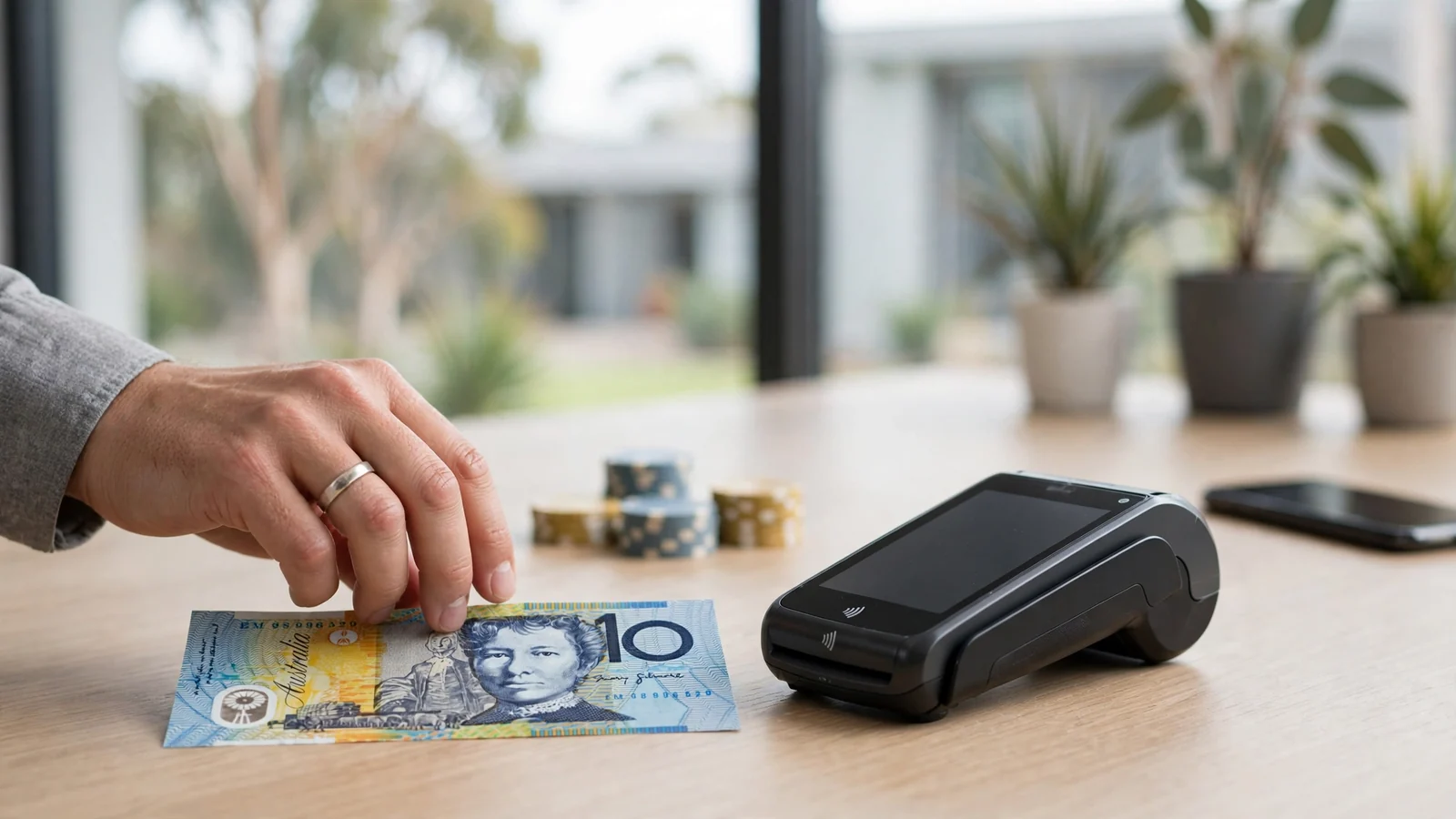
A specialist review describes PayID deposits as near-instant and typically free. That is a report about the payment option, not a guarantee that every transaction will arrive at that speed or carry no charge. Availability depends on the operator’s current cashier, and a bank or payment provider may apply its own controls. The cashier’s displayed conditions therefore matter more than a general description of PayID.
A specialist review also lists PayID, BPAY, cards and cryptocurrency among deposit methods offered by mobile casinos, with processing times varying by method and operator. These options are not interchangeable. A card transaction may be declined or flagged by a bank, while a cryptocurrency transfer follows a different payment process from a bank-linked method. The available deposit list should be checked before funds are sent, rather than inferred from a payment logo or an old review.
POLi is not a current route for Australian transactions: the service shut down its Australian operations in September 2023. A cashier that still displays POLi may be showing outdated information, or a route that does not process local payments. The name alone is not evidence that a deposit will go through.
The more consequential timing difference often appears at withdrawal. A specialist review reports that crypto and e-wallet payouts can be processed in under 24 hours, while another reports that e-wallet funds may arrive within 24 hours after the casino’s pending period. Those are distinct stages: the operator may first hold a request for review, and only then send it to the payment provider. The time shown for processing should not be read as the time until funds are available in an account.
Bank transfers can take up to five business days for withdrawals, according to a specialist review. That estimate also begins after the operator’s own handling and verification, not necessarily when the withdrawal button is selected. Weekends, bank processing and operator procedures can affect the elapsed time. For cash-flow planning, the relevant measure is the full path from request to cleared funds, not the fastest stage in isolation.
Do
- Confirm the site accepts your actual location before depositing
- Verify eligible withdrawal methods and account-name requirements
- Prepare identity documents and proof of address for verification
Don’t
- Assume a deposit method is also available for withdrawals
- Use a VPN to bypass blocks, as this may void winnings
- Rely on reported processing speeds without checking pending periods
The first withdrawal commonly brings identity checks. A casino may request a selfie or identity document and proof of address before approving payment. This is a separate condition from the speed of the payment rail. Until the requested documents are accepted, a fast transfer method does not make the payout fast. Incomplete, inconsistent or outdated details can leave the request waiting for review.
Payment rules may also restrict the route back. Some operators require a withdrawal to use the same method as the deposit, while other methods are deposit-only. A method available for funding is therefore not automatically available for cashing out. Before depositing, the payment terms should be checked for the eligible withdrawal methods, account-name requirements, verification steps and any pending period. If the preferred withdrawal route is unavailable, the nominal speed of the deposit method has little practical value.
These checks sit within a broader legal and access context. The Interactive Gambling Act 2001 prohibits operators from providing real-money online casino games to people in Australia. Individual players are not made liable under that Act merely for playing at an offshore casino, but that does not make the service locally regulated or protected. The Australian Communications and Media Authority blocks access to illegal gambling sites, and offshore access may not remain available. Any offshore crypto-friendly casino must be confirmed as accepting the punter’s location before a deposit is considered. A VPN used to reach a blocked casino may breach its terms, void winnings or lead to account closure.

There is no Australian government body to approach for a complaint if an offshore casino refuses to pay winnings. That changes the financial assessment: a displayed payment option and a published processing estimate are not the same as an enforceable local remedy. Payment details should be read alongside the operator’s terms, not treated as proof of protection.
A further distinction applies to mobile access. Sideloaded casino apps carry security risks, and their safety depends on the operator. A payment screen reached through an app does not remove the need to verify the destination and the payment conditions. Where a site is blocked, bypassing that block does not make the service safer or create a local complaint route.
For a no-deposit search, the payment question still needs to be kept precise: a deposit route describes how funds enter an account, not whether an offer provides cash without a deposit or how a payout will be handled. PayID’s reported speed and cost concern deposits; verification, pending periods, method restrictions and bank processing govern the route back.
Lightning Link on Mobile: Browser Access, Not a Verified Game Guide
The name Lightning Link is not enough to establish that a particular pokies title is available on a mobile casino, in a browser, or for real-money play. It should not be treated as a verified game guide. Mobile access can be described separately from the identity or availability of any individual game.
In Australia, the legal distinction matters: the Interactive Gambling Act 2001 prohibits operators from providing real-money online casino-style games to people physically located in the country. ACMA also blocks access to illegal gambling sites. A site appearing on a phone, or opening in a browser, does not make its real-money casino service lawful for Australian customers. This section is informational, not an invitation to use one.

Browser access and home-screen shortcuts
Browser play is the standard mobile access route described for casinos that accept Australian players; native casino apps are rarely available through Google Play or Apple’s App Store in Australia. A mobile browser can use the same account as the desktop version, where a service offers that access. This says nothing about whether a specific title is present or playable.
Some casino websites also offer a Progressive Web App, or PWA. It is a website shortcut that opens in an app-like format on a mobile device, rather than a separate native app downloaded from an app store. Where the website provides the option, installation involves selecting its install or add-to-home-screen prompt and confirming. The shortcut changes how the website is reached; it does not verify a game, alter the operator’s legal position, or establish that the service is safe.
A browser session is therefore the more straightforward way to assess basic site access without installing an app file. A PWA remains tied to the website behind it. If the website is blocked, unavailable, or changed by its operator, the shortcut does not create an independent service.
App files and security
An app offered for download outside the established app stores is a different proposition from a browser bookmark or PWA. Sideloaded casino apps carry security risks, and their safety depends on the operator. A polished icon or app-like screen is not evidence of independent security checks. Nor does installing a file establish that the operator is authorised to provide real-money casino games to people in Australia.
Casino apps are not commonly distributed through the major Australian app stores, so a request to install an external file warrants caution rather than being treated as a routine step. The distinction is practical: a website can be opened in a browser without installing software, while a sideloaded app requires trusting the file and the party supplying it. The latter adds a device-security decision without confirming that Lightning Link is included.

Connection problems do not verify a game
A specialist review identifies weak connectivity, limited available memory, an outdated browser, and too many open background apps as possible causes of mobile casino difficulties. These are troubleshooting considerations, not proof that a game exists on the site. A slow loading screen cannot distinguish between a device issue, a website problem, or a title that is simply unavailable.
If a site does not load, switching repeatedly between app files and browser pages does not resolve the legal or security questions. A browser can be updated and unnecessary background activity closed, but successful access would still establish only that a page loaded. It would not verify a particular game or make prohibited real-money service lawful.
Location and recourse
Any site’s stated availability must be checked before attempting to register or deposit; acceptance of a location should not be inferred from an accessible page. Offshore operators may describe themselves as crypto-friendly, but that label is not a local authorisation or a guarantee of access. Use of a VPN to reach a blocked casino may breach the operator’s terms, void winnings, or lead to account closure. ACMA’s blocking activity means access can also change.
There is no Australian government body to complain to if an offshore casino refuses to pay winnings. That leaves the punter with limited practical recourse, quite apart from the question of whether a game loads on mobile. An app, browser tab, or home-screen shortcut cannot remove that exposure. The available mobile route is therefore a technical description only; it is not confirmation that Lightning Link is offered, nor a recommendation to seek real-money play from Australia.
Can I play for free at Australian mobile casinos?
Yes. Social and free-play casino apps using virtual credits are available in Australia, but those credits are not cash and do not make winnings withdrawable.
Can I play mobile casinos for real money without an app?
Yes, offshore casinos that accept Australian players are commonly accessed through a mobile browser, usually with the same account used on desktop. Australian law prohibits operators from offering real-money online casino games to people in Australia, although playing offshore is not itself illegal for an individual under the Interactive Gambling Act.
What is the real difference between a native app and a mobile browser casino?
A browser casino is accessed through a mobile browser, while a Progressive Web App is a shortcut to the casino website that behaves like an app and can be added to the home screen. Native casino apps are rarely listed in Australia’s Google Play Store or Apple App Store.
Is it safe to play at mobile casinos in Australia?
Offshore casinos do not have Australian authorisation, and a foreign licence does not provide an Australian complaints process. If an operator refuses to pay, there is no Australian government body to handle a complaint about it.
Created by the ”Oscarspin Casino” editorial team.