






No-Deposit Casino Bonuses in Australia: Rules
 Available in AU
Compare bonus types, eligibility checks and withdrawal conditions, while keeping the legal limits on online casino services in Australia in view.

Table of Contents
- Online Casino Bonuses and the Australian Legal Boundary
- What a No-Deposit Offer Actually Gives
- Free Cash, Free Spins and the Games They Cover
- Bonus Codes: Where They Apply and What They Change
- When Bonus Winnings Become Withdrawable
- Sign-Up Checks and Offers That Need a Deposit
- How to Read a No-Deposit Offer Side by Side
- Checking Whether a Casino Code Is Still Valid
- PayID Deposits and No-Deposit Withdrawals
- Pokies Free Spins and Bonus-Bet Limits
Online Casino Bonuses and the Australian Legal Boundary
“Online” describes how a casino service is delivered: games are accessed remotely through a website or app rather than at a physical venue. A no-deposit offer attached to that service does not change its legal character. If it is an inducement to play casino games for real money, the relevant question in Australia is not whether the operator is based locally or overseas, but whether the service is being offered to people located in Australia.
The Interactive Gambling Act 2001 places the restriction on providers. It makes it unlawful for an entity to supply real-money online casino games to people in Australia. That prohibition covers interactive pokies, online poker and casino table games, whether the provider operates from Australia or from another country. Moving the website, company or server offshore does not make the service permissible for Australian customers.
This distinction matters when an offer is described as a new online casino no-deposit bonus or as a real-money casino promotion with no initial payment. The promotional label does not create a separate legal category. Where the offer leads into real-money casino play, the underlying service remains the issue. “No deposit” describes a commercial condition; it does not grant an exemption from the rules governing online casino services.
A no-deposit bonus can be a way to explore a casino before committing funds, but the available operator details are limited. Use this list as a starting point and check each casino’s current bonus terms and eligibility rules before signing up.
License: Curacao Gaming Control Board OGL/2023/174/0082 (Dama N.V.) SpinsUp is listed with a Curaçao Gaming Control Board licence, OGL/2023/174/0082, held by Dama N.V. The supplied details do not specify its no-deposit bonus terms.
License: Curacao – Antillephone N.V. (Versus Odds B.V.) · Min. deposit: EUR 20 Thor Casino is listed under a Curaçao licence involving Antillephone N.V. and Versus Odds B.V. Its stated minimum deposit is EUR 20; no no-deposit bonus terms are provided.
License: Curacao Gaming Control Board (TechSolutions Group N.V.) Bizzo Casino is listed with a Curaçao Gaming Control Board licence associated with TechSolutions Group N.V. The supplied information does not describe its bonus offer.
License: Curacao Gaming Control Board OGL/2023/176/0095 (Hollycorn N.V.) GoldenCrown is listed with Curaçao Gaming Control Board licence OGL/2023/176/0095, held by Hollycorn N.V. No details about a no-deposit bonus are provided.
License: Curacao eGaming OGL/2023/174/0082 (Dama N.V.) · Min. deposit: A$15 LevelUp Casino is listed with Curaçao eGaming licence OGL/2023/174/0082, held by Dama N.V. Its stated minimum deposit is A$15, while no no-deposit bonus terms are specified.
License: Curacao Gaming Control Board OGL/2023/176/0095 (Hollycorn N.V.) Rollero Casino is listed with Curaçao Gaming Control Board licence OGL/2023/176/0095, held by Hollycorn N.V. The supplied details do not state whether it offers a no-deposit bonus.
License: Curacao eGaming OGL/2024/923/0383 (Antillephone N.V.) · Min. deposit: A$30 WinSpirit Casino is listed with Curaçao eGaming licence OGL/2024/923/0383, associated with Antillephone N.V. Its stated minimum deposit is A$30; no bonus terms are given.
License: Curacao eGaming (Roby Games Ltd) Roby Casino is listed with a Curaçao eGaming licence associated with Roby Games Ltd. The available information does not detail its no-deposit offer.
License: Curacao Gaming Control Board JustCasino is listed with a Curaçao Gaming Control Board licence. No further operator or bonus details are supplied.
License: Curacao (operating since 2017) · Min. deposit: A$20 Uptown Pokies is described as operating since 2017 under a Curaçao licence. Its stated minimum deposit is A$20, but no no-deposit bonus terms are provided.
The law’s focus on operators should not be confused with permission for the service itself. Australian residents do not face criminal or civil penalties merely for accessing, registering with or playing at an offshore online casino. That position is different from saying that an offshore operator may lawfully provide casino games to them. The provider’s prohibition and the player’s lack of liability are separate parts of the legal boundary.
That separation can be easy to miss in promotional language. A page may present an online casino with a no-deposit bonus as if it were an ordinary offer available to local customers. Yet the existence of a page, account form or promotion does not establish that the underlying service is lawful to supply in Australia. Nor does a foreign location for the operator alter the rule that applies to services offered to people physically in the country.
The boundary concerns real-money interactive gambling, not merely a particular kind of game or payment arrangement. Online pokies, poker and table games are within the prohibited category when supplied as real-money casino services to people in Australia. A bonus attached to those games does not make them a different product. Whether an offer is framed as free cash, spins or another promotional credit belongs to its commercial terms; it does not answer the prior question of whether the casino service may be offered in this market.

There is also a practical side to the legal position. Offshore casino services are actively blocked and enforcement is part of the Australian approach. A website being visible at a particular moment is not evidence of regulatory approval or a locally valid casino licence. The market does not provide a route to a locally licensed real-money online casino simply because a foreign operator accepts Australian registrations or displays Australian-facing promotions.
Consequently, the phrase “online casino bonus no deposit” should be read as a description of an offer made by an operator, not as a statement that the offer is authorised in Australia. The same applies to claims about a casino free bonus requiring no deposit or a bonus attached to real-money play. Promotional wording can describe what an operator says it will provide; it cannot override the legal restriction on providing the underlying games to people in Australia.
The financial decision and the legal boundary are related but not interchangeable. A bonus may appear to reduce the cost of starting an account, while leaving the nature of the activity unchanged. No initial payment does not convert real-money casino gambling into a permitted service, and an offshore location does not shift responsibility for offering that service away from the operator. The law is concerned with provision to people in Australia, not with the marketing label placed on an account incentive.
Legal Boundary
Under the Interactive Gambling Act 2001, it is unlawful for an entity to supply real-money online casino games to people in Australia, regardless of where the provider is based.
Risks also extend beyond the legal distinction. An offshore operator does not bring Australian consumer protections into play merely by accepting customers from Australia. If it refuses a withdrawal or disputes a win, there may be no Australian consumer-protection route for resolving that disagreement. BetStop does not cover offshore online casinos. These are practical limits, separate from the fact that residents are not subject to criminal or civil penalties simply for playing.
The result is a clear boundary: an offshore no-deposit promotion may be advertised as available, but the provider may not lawfully supply real-money online casino games to people physically in Australia. The offer’s wording does not alter that position, and a player’s lack of legal liability does not amount to regulatory approval of the operator.
What a No-Deposit Offer Actually Gives
A no-deposit offer is a promotional credit made available after an account is created, without requiring a deposit as the condition for receiving it. The credit may take the form of free cash or free spins. That definition describes what is added to an account, not what can later be transferred out of it.
The distinction matters because a displayed bonus amount is not automatically a cash balance. It is promotional value governed by conditions. Before any resulting winnings can be withdrawn, the offer may require wagering and account verification. Other terms may limit eligible games, set a maximum cashout, or impose an expiry period. Each condition changes the practical value of the headline figure.
A useful way to read the offer is as a sequence of balances. First comes the promotional credit. Then, if the rules allow, play produces a balance that may include winnings. Finally, only an amount that satisfies the offer’s conditions can become eligible for withdrawal. These stages are not interchangeable. A balance visible in the account does not by itself establish that the same amount is payable.
The wagering calculation
A wagering requirement multiplies the bonus amount by the stated requirement to determine how much must be bet before the withdrawal condition is met. It measures turnover, not profit and not a guaranteed loss or return. A requirement of 40× attached to a AU$20 bonus means AU$800 in total bets are required before cashout. A player could reach that turnover with winnings, losses or a changing balance; the calculation alone does not predict the amount left at the end.
The same arithmetic applies at a smaller scale: a AU$10 bonus with 40× wagering requires AU$400 in bets. The lower starting credit reduces the required turnover, but it does not remove the condition. Nor does completing the turnover automatically establish that the full balance is withdrawable. A cashout cap, game restriction, expiry rule or verification condition may still affect the result.
Published descriptions do not give one uniform multiplier. A specialist review of Australian-facing offers reports requirements ranging from 40× to 60×, while another specialist review describes a range from 40× to 70×. Those are attributed descriptions, not a single rule applying to every offer. The terms attached to the specific credit determine the calculation.
Wagering Calculation
Determine the starting credit, such as AU$20.
Multiply the bonus by the requirement (e.g., 40×), resulting in AU$800 in total bets.
Accumulate bets until the total reaches the required amount before requesting a cashout.
Headline value and payable value
The headline amount answers a narrow question: how much promotional credit is being advertised? It does not answer how much can be withdrawn. That second figure depends on the conditions attached to the offer and on the balance remaining after play.
For instance, a bonus may have a maximum cashout cap. If the resulting winnings exceed that cap, the permitted withdrawal may be lower than the displayed balance. If the amount left is below a withdrawal threshold, it may also fail to meet the operator’s payment condition. These are separate constraints: wagering determines when a balance may qualify, while a cap or threshold can alter whether, or how much, qualifies for payment.
The distinction is particularly important when an offer is presented as “free.” No deposit is required to receive the promotional credit, but that does not make the credit unrestricted cash. The offer still has a price in conditions: required wagering, eligible play, time limits and possible limits on the amount payable. “No deposit” describes the entry condition, not the withdrawal outcome.
A sound comparison therefore starts with the amount credited but does not stop there. The relevant figure is the balance that could remain after the wagering condition is completed, subject to the offer’s other terms. Without those terms, the headline amount is only the starting point of the calculation.

The format also affects how the credit is used, but that is a separate question from its cash value. Free cash and free spins are not necessarily governed by identical play rules. In either case, the label on the offer cannot replace the conditions that define eligible play and withdrawal. A credit that appears generous may have limited practical value if the required turnover is substantial or the payable amount is capped.
For accounting purposes, the offer should be treated as conditional credit until the withdrawal requirements have been met. The promotional amount is not itself the final payout; the final amount depends on the balance produced, the wagering completed and the remaining terms. That is the difference between a bonus figure and money available to withdraw.
Free Cash, Free Spins and the Games They Cover
A no-deposit offer can arrive as cash credit, free spins or a no-deposit chip. These formats are not interchangeable. Cash credit may be available across eligible games, while spins apply to a particular game and a chip may have a narrower selection of permitted titles. The format determines where the offer can be used; the game’s contribution rate determines how much wagering progress each stake creates.
Free spins are linked to a named pokie rather than being a general balance for any game. A specialist review describes free-chip offers as usable on selected slots, but that should be treated as a description of particular offers, not a rule that applies across casinos. The terms for the offer in question control. A spin allocated to one pokie cannot be assumed to work on another, and a chip’s stated value does not establish that every game accepts it.
Available across eligible games; usefulness depends on specific game contribution rates.
Linked to a named pokie; any resulting winnings remain subject to applicable offer rules.
A credit with game restrictions; usable on selected titles with specific contribution rates.
The distinction matters when wagering is attached. If a game contributes fully, each eligible stake counts at its full amount toward the requirement. If it contributes only a fraction, the same stake produces less progress. For example, a $10 wager on a game contributing 10% adds $1 of wagering progress; at 3%, it adds 30 cents. The remaining stake still leaves the balance, but most of it does not count toward clearing the requirement. That is a material difference, not a technical footnote.
Pokies generally contribute 100% toward wagering. Blackjack, baccarat and roulette are commonly assigned a much lower rate, in the range of 0–10%. A separate set of terms may put table games at as little as 10% and live-dealer rounds at as little as 3%. These figures describe contribution, not the chance of winning: a high contribution rate does not make a game more favourable, and a low rate does not make a wager smaller.
The practical calculation is straightforward. A $10 stake on a pokie with full contribution can add $10 to wagering progress. The same stake on a table game contributing 10% adds $1; on a live-dealer game contributing 3%, it adds 30 cents. If the offer’s eligible-game list does not include the chosen title, the wager may not count at all. A balance can therefore be active while the required progress barely moves.
No-deposit offers also commonly exclude categories such as progressive jackpots, table games and live-dealer titles. The exact exclusions vary by offer, so the game catalogue alone is not enough to establish eligibility. A title may be visible and playable in the casino while still being outside the bonus rules. Where the terms name eligible games or identify excluded categories, those rules determine contribution.

Cash credit has a different shape from spins. It can be expressed as an amount available for wagering, but its usefulness still depends on which games accept it and how those games contribute. A cash figure by itself says nothing about whether roulette, blackjack or a live table will count at full value, at a reduced rate or not at all. Treating the displayed amount as a universal playing balance skips the condition that does the accounting.
Spins are more constrained by design: their value is attached to specified rounds on a specified game, and any winnings they produce remain subject to the offer’s applicable rules. A no-deposit chip sits between the two formats. It is a credit with game restrictions rather than a set of individual spins, and selected titles may be allowed while others are not. The labels describe the form of the benefit; they do not settle the wagering treatment.
A useful comparison begins with two separate questions: what form is credited, and which games count toward the requirement? For cash, the relevant detail is the eligible-game contribution table. For spins, it is the named pokie and the treatment of resulting play. For a chip, it is the permitted game selection and contribution rate. Without those details, comparing offers by their headline value is incomplete.
The game contribution can change the amount of activity needed to generate the same wagering progress. Full contribution makes progress track eligible stakes one for one; a reduced rate stretches the amount of play required. Excluded games add no useful progress toward the offer, even if they remain available for ordinary play. In bonus accounting, the game category is therefore part of the offer’s value, not merely a preference about what to play.
Game Contribution
While pokies generally contribute 100% toward wagering, table games and live-dealer rounds often contribute significantly less, ranging from 0% to 10%.
The central distinction is simple: cash, spins and chips specify how the bonus is delivered; game rules specify how wagering progress is counted. Both have to be read together. A generous-looking credit restricted to low-contribution or excluded games may produce less progress than a smaller offer that applies to fully contributing pokies. The arithmetic is determined by the terms, not by the label on the promotion.
Bonus Codes: Where They Apply and What They Change
A no-deposit offer can be attached to an account automatically, or it can require a bonus code during registration or in the cashier. A specialist review describes both activation routes; neither should be assumed without checking the particular offer’s instructions. The code is not the bonus itself. It is an identifier used to connect an account with specified promotional terms.
The entry point matters. A code requested during registration may need to be entered before the account is created, while a cashier field may be available only after sign-up. If the stated field is skipped, entering the same code elsewhere may not activate the offer. Conversely, an offer credited automatically may not need a code at all. The practical distinction is procedural: identify whether activation is automatic or code-based, then follow the stated route.
A casino no-deposit bonus code also needs to match the offer it is meant to activate. Codes can be associated with different promotions, and a code copied from one offer may not apply to another. Similar wording is not proof of equivalence. The terms attached to the specific offer determine what the code is intended to unlock, so the offer description and the code should be read together rather than treated as separate pieces of information.

That match affects more than the label shown in an account. No-deposit terms may include wagering requirements, eligible games, a maximum cashout cap and an expiry period. A code that activates a different promotion can therefore attach different conditions, even where the headline description appears similar. The relevant check is not simply whether the code was accepted, but whether the account received the intended offer and its associated terms.
A useful sequence is to record the offer name, the stated activation method and the conditions displayed before submitting anything. If a code is required, compare its spelling and any stated eligibility wording with the offer details. After activation, check the account’s bonus area for a corresponding credit or status. A confirmation message can show that an entry was processed; it does not, by itself, establish that the intended promotion was applied.
For a no-deposit welcome bonus, the word “welcome” describes the offer’s intended audience, not necessarily its activation method. It may be automatic or code-based. Nor does “no deposit” mean that a code overrides the offer’s other conditions. A casino no-deposit bonus for real-money play remains governed by the terms attached to that promotion, including any restrictions on games or use. The code changes which offer is associated with an account; it does not rewrite the offer.
Do
- Record the offer name and activation method
- Compare code spelling with offer details
- Check the account bonus area after activation
Don’t
- Assume an offer is automatic without checking
- Repeat a rejected code in unrelated fields
- Treat a successful submission as proof of eligibility
If a code is rejected, repeating it in unrelated fields is unlikely to clarify the reason. Possible explanations include a mismatch between the code and the offer, a field intended for a different stage, or conditions that the account does not meet. The available information should be checked against the stated instructions before assuming the offer has been activated. Where the account shows no matching credit or promotion status, the activation result remains uncertain.
“No KYC” wording should not be read as a promise that a code removes identity checks or other account requirements. A code concerns promotional activation. It does not, on its own, establish that the account qualifies for an offer or that later checks will be waived. Those are separate conditions and need to be assessed separately.
The cleanest record is the offer wording, the code entered if one was required, the field in which it was entered, and the resulting account status. That makes it possible to distinguish an activation problem from a disagreement about the promotion’s terms, without treating a familiar code or a successful submission as proof that every condition has been met.
When Bonus Winnings Become Withdrawable
A no-deposit bonus is not the same as cash available to withdraw. The amount shown as bonus credit may have to pass a wagering requirement first, and the resulting winnings can still be limited by a maximum cashout cap and a minimum withdrawal threshold. The final amount depends on all three conditions, not on the headline bonus alone.

Wagering is turnover, not a payout
A wagering requirement sets how much must be staked before a withdrawal can be requested. For a AU$20 bonus with a 40× requirement, the calculation is AU$20 × 40 = AU$800 in bets. A AU$10 bonus at 40× requires AU$400 in bets. Those figures describe cumulative wagering, not money that must be deposited or the amount that will remain in the account afterwards.
Completing the required turnover does not establish that the balance will equal the bonus multiplied by the wagering figure. Bets can lose, and the terms may also restrict which games contribute towards progress. The relevant withdrawal figure is the eligible balance remaining when the wagering condition is complete, subject to the other limits.
The cap can reduce the eligible amount
No-deposit offers aimed at Australian players commonly set a maximum cashout between A$50 and A$200. If eligible winnings exceed the stated cap, the cap limits what can be withdrawn from those winnings. The balance displayed before cashout can therefore be larger than the amount payable.
For instance, if a completed bonus produces winnings above the offer’s cap, the cap—not the displayed balance—sets the maximum eligible payout. If the winnings are below the cap, the cap does not increase them. It is a ceiling, not a promised cash amount.
The minimum can block a smaller balance
The minimum withdrawal creates a separate test. A specialist review reports that minimum withdrawal thresholds at many AU-facing offshore casinos fall between A$25 and A$100. A balance below the applicable threshold may not be withdrawable, even if the wagering requirement has been completed.
Order of Withdrawal Checks
- Wagering: The required turnover must be completed first.
- Cashout Cap: The maximum eligible winnings are limited by the cap.
- Minimum Withdrawal: The remaining balance must meet the operator’s minimum threshold to be processed.
The order of the checks matters. First, the required wagering must be completed. Then the cashout cap limits eligible winnings, while the minimum withdrawal determines whether the remaining balance reaches the amount the operator will process. A balance can pass one test and fail another: completing wagering does not remove a cap, and staying below the cap does not satisfy a minimum.
A practical calculation therefore starts with the balance after wagering, applies the offer’s cashout cap, and compares the resulting eligible amount with the stated minimum withdrawal. If the eligible amount is lower than that minimum, the bonus may produce no payable withdrawal under those terms. If it clears the minimum, the amount remains subject to the cap and the operator’s withdrawal conditions.
For anyone assessing an online casino no-deposit bonus as real money, the useful figure is not the opening credit. It is the amount left after wagering, capped where required, and high enough to meet the withdrawal threshold.
Sign-Up Checks and Offers That Need a Deposit
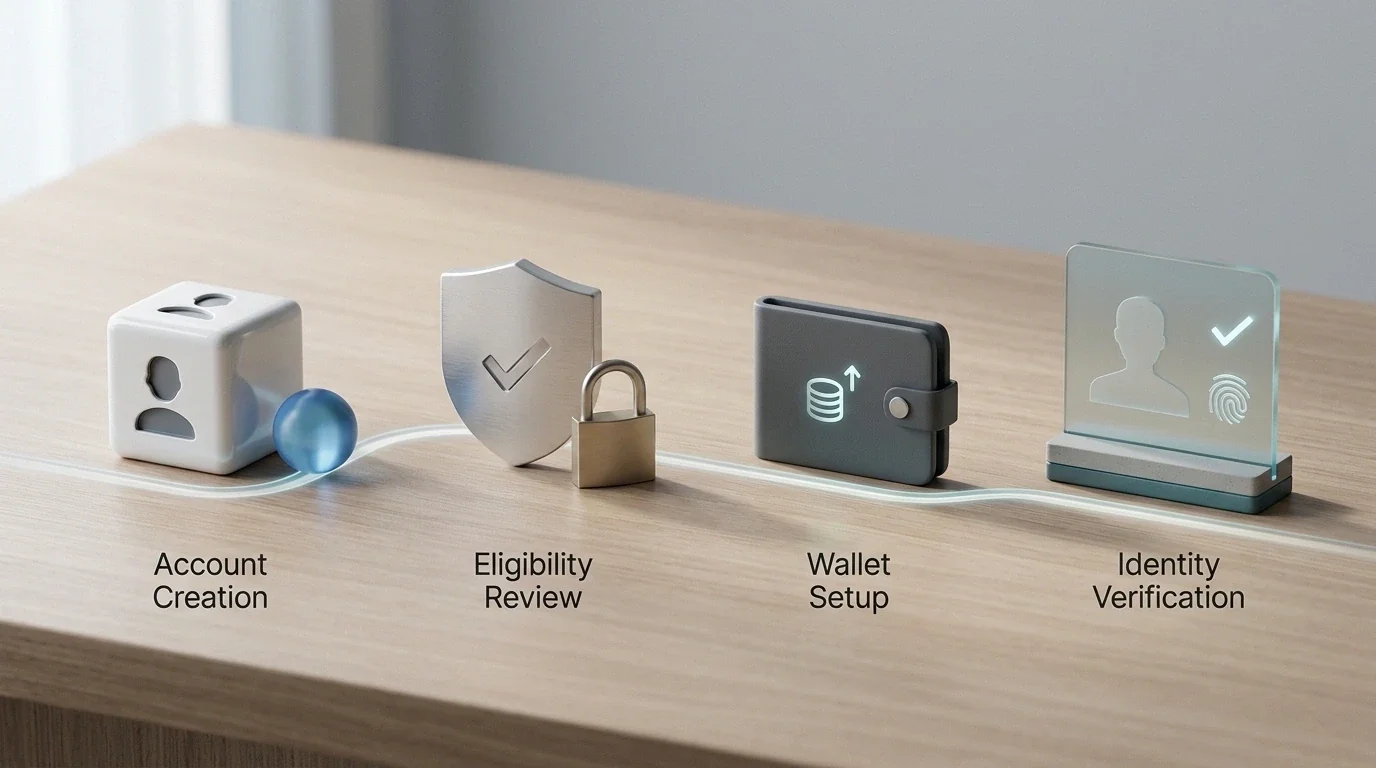
A sign-up offer is not fully assessed at the point an account is created. The eligibility conditions may include an email check, and the account holder may need to complete it before the bonus is credited or usable. That is a separate condition from making a payment: an offer can require verification and still be genuinely no-deposit.

The timing should be read from the offer’s own terms. One specialist review describes a verification link that must be used within 24 hours. That is a reported condition, not a deadline that can be assumed to apply across Australian-facing offers. If the link expires, the review does not establish what remedy is available; the operator’s stated terms determine whether verification can be repeated or the offer is lost.
A no-deposit label also needs to be tested against the activation requirement. Some offers described in listings require a minimum deposit of A$5 before the bonus becomes active. A specialist review reports this condition for some listed offers; it should not be treated as a general rule. Where payment is mandatory, the offer is not deposit-free in practical terms, even if the bonus itself is described as a sign-up reward.
The distinction is simple in the account’s transaction history: creating an account and verifying an email involve no deposit; an activation condition that requires funds does. The headline label cannot override that condition. The relevant terms should state whether a payment is required before any bonus credit appears and whether the account must also pass verification.
Verification may remain relevant later as well. No-deposit winnings are generally subject to both wagering and verification requirements before withdrawal, so successful registration does not itself settle eligibility for a payout. Those are separate checks: one concerns whether the account can receive or retain the offer, while the other concerns whether resulting winnings can be withdrawn.
Attention: Some offers described as no-deposit may actually require a minimum deposit (e.g., A$5) before the bonus becomes active.
For a genuine no-deposit offer, the account should not need a payment to activate the advertised bonus. If the terms specify a required deposit, the accurate description is a deposit-conditioned sign-up offer, not a no-deposit one. The difference is small in wording and decisive in the account balance.
How to Read a No-Deposit Offer Side by Side
A no-deposit offer is materially different from another only when its conditions change the amount of wagering required, the games that count, the winnings eligible for cashout, or the time available to meet the terms. A headline credit figure cannot show those differences by itself.
Start with the wagering multiple and the amount it applies to. A specialist review of AU-facing offers describes multiples in the 40× to 60× range; that is a reported range, not a fixed rule for every offer. The calculation also depends on whether the multiple applies to the bonus alone or to a different stated base. Compare both the multiplier and its calculation base before judging the burden.
Next, record the maximum cashout cap. Two offers with similar wagering terms can have different ceilings on the winnings that may be withdrawn, so a higher bonus amount does not necessarily make one more valuable. The cap is a separate condition, not a substitute for checking the wagering requirement.
Then compare game contribution and restrictions. A game may be permitted but contribute less toward wagering than another, or may be excluded altogether. Terms should make clear which games count and at what rate; otherwise, the apparent wagering target may not reflect the actual play required.
Finally, compare expiry. An offer with a shorter validity period leaves less time to satisfy its conditions, even if its other terms look similar. Record when the period begins and which part of the offer expires, where the terms specify those details.
A useful comparison table has four rows: wagering multiple and base, cashout cap, game contribution and restrictions, and expiry. Blank or unclear terms are not neutral differences; they prevent a reliable comparison. The strongest apparent offer on one row may be weaker once the other conditions are included.
Checking Whether a Casino Code Is Still Valid
A “latest” label is not a validity period. It says nothing by itself about when an offer was issued, whether its terms have changed, or whether a particular code remains eligible for use. The controlling record is the offer’s current terms, including any stated expiry and the point at which the bonus must be claimed.
A specialist bonus review reports that some no-deposit offers are credited automatically, while others require a code to be associated with the account during sign-up or through the cashier. That distinction matters when checking a code’s status: an offer that is still listed may not apply if its required activation step was missed. The listing alone does not establish that the code is active or that the account qualifies.
Timing can also differ by bonus format. A specialist review describes a seven-day validity period for most no-deposit cash bonuses and a 72-hour expiry for free spins. Those periods should be treated as terms reported for offers, not as a universal rule. The expiry stated for a specific offer takes precedence; where no date or period is shown, its current availability is uncertain.
Verify Code Validity
- Check if the offer is still listed as available
- Identify any specified expiry date or time limit
- Confirm if the offer requires manual code activation
- Compare current terms with the code description
A practical check is to compare the code’s stated conditions with the offer attached to it: whether it is still listed as available, whether an expiry is specified, and whether the offer requires code activation. If the displayed terms and the code description conflict, the apparent “latest” status does not resolve the discrepancy. A dated page can preserve an old promotion just as neatly as a live one.
The useful distinction is between a code that exists in a listing and an offer that is valid under its current conditions. Without a clear expiry or confirmation that the offer remains available, the headline label is not evidence of either.
PayID Deposits and No-Deposit Withdrawals
PayID is a deposit method, not a promise that a no-deposit balance can be paid out through the same channel. At Australian banks, PayID payments are described as free and settling within seconds. A transfer is addressed using an email address or mobile number, rather than the recipient’s BSB and account numbers.
That distinction matters when a bonus produces winnings. Offshore casinos serving Australian customers commonly use bank transfers for withdrawals instead of PayID. The deposit route and the payout route can therefore be different, even where PayID appears in the cashier.
A further condition may apply before a withdrawal is processed: the casino could ask for a PayID deposit to link or confirm the bank account. A specialist review reports this as a possible requirement, not a universal rule. If imposed on a no-deposit balance, it changes the practical meaning of “no deposit”: no payment may be needed to receive the offer, but funds could still be required to establish a withdrawal route.
The relevant figures are the amount requested for account linking and the balance eligible for payout. Those conditions should be checked in the payment and withdrawal terms before treating a displayed bonus balance as accessible cash. A PayID logo alone confirms neither that withdrawals use PayID nor that a bank transfer will be available without an additional deposit.
PayID’s speed describes how a bank deposit settles; it does not establish the processing time for a casino withdrawal. The payout method, any account-linking condition and the withdrawal terms determine what happens after winnings become eligible for payment.
Pokies Free Spins and Bonus-Bet Limits
For an online pokies no-deposit offer, free spins and wagering contribution are separate conditions. Spins may produce winnings, but whether those winnings count toward a wagering requirement depends on the offer’s rules. Pokies are generally credited with 100% contribution, so eligible bets on them can count in full. That does not remove the wagering requirement or make every spin eligible: the specific game and bonus terms still govern.
The stake ceiling is a separate control. A specialist review reports maximum bets on bonus funds in the A$5 to A$6.50 range, but that is not a universal limit. The operative figure is the one stated in the particular offer. Exceeding it during wagering can void the bonus, which may also put associated winnings at risk. A larger stake does not simply clear the requirement faster; if it breaches the terms, the balance can be disqualified instead.
Free spins therefore need to be assessed alongside the rules for any winnings they generate and the maximum permitted stake. If spins are followed by wagering on bonus funds, the stake limit may apply to those later bets. The wording matters: a restriction may be attached to bonus funds or to the wagering process, rather than only to the free spins themselves.
These conditions describe how an offer’s mechanics can work; they do not alter the Australian legal position. The Interactive Gambling Act 2001 prohibits operators from providing real-money online casino games to people in Australia. A promotional label does not change that boundary.
Is a $10 no-deposit bonus really free at Australian online casinos?
It may be credited without an initial deposit, but it is promotional credit, not automatically withdrawable cash. Wagering requirements, cashout limits, game restrictions and expiry terms can apply.
What is a no-deposit bonus at an Australian casino?
It is promotional credit, such as free cash or free spins, offered after account creation without requiring a deposit to receive it. Wagering and other terms may apply before winnings can be withdrawn.
Do you need a bonus code to claim a no-deposit bonus?
Not always: some offers are credited automatically, while others require a code during sign-up or in the cashier.
Why do casinos require a $10 deposit before I can withdraw a free bonus?
Some operators require a minimum PayID deposit to link a bank account before withdrawing no-deposit bonus winnings. Check the offer’s terms for the required amount and any other withdrawal conditions.
Do casinos require identity verification before withdrawing no-deposit bonus winnings?
Yes, verification is generally required before withdrawal, and some offers also require email verification.
Prepared by the Oscarspin Casino editorial staff.