






Australian Online Pokies: Laws, Offers and Payments
 Available in AU
A practical overview of offshore online pokies, covering legal status, deposits, bonus conditions, verification and withdrawal limits.

Table of Contents
- The Legal Position on Real-Money Online Pokies
- PayID Transfers and Other Deposit Routes
- How Pokie Outcomes and Return Settings Work
- No-Deposit Offers: The Turnover Behind the Headline
- Free Spins and the Cash-Out Cap
- Signup Offers, Verification and Withdrawal Conditions
- Mobile Access and Account Safeguards
- Online Casino Terms and the Land-Based Machine Context
- Trust, Payout Limits and Offshore Redress
- New Pokies: What Can Be Verified
The Legal Position on Real-Money Online Pokies
The Interactive Gambling Act 2001 draws a clear line between the conduct of an online gambling operator and that of an individual player. A company must not provide real-money online pokies to people in Australia without a domestic licence. No licences for online casinos have been issued in Australia, so there is no Australian-licensed online casino offering real-money play.
The prohibition covers online casino-style games, including pokies, when they are supplied to customers in Australia. An offshore operator does not become authorised to serve Australian residents simply because it holds a licence elsewhere or makes its website accessible from Australia. The relevant legal restriction concerns the service provided to people in the country, not the operator’s description of its own status.
The law targets operators, not individual players. Australians are not made criminally liable simply for playing on an offshore site that accepts them. That distinction matters, but it does not make an offshore casino a locally regulated service. A player’s lack of liability is not the same as a player having the protections or remedies available under an Australian licensing system.
Choosing online pokies in Australia calls for a careful look at the details available for each operator. This list offers a concise reference to their stated licensing information and any listed minimum deposit.
License: Curacao Gaming Control Board OGL/2023/174/0082 (Dama N.V.) SpinsUp is listed with a Curacao Gaming Control Board licence, OGL/2023/174/0082, held by Dama N.V.
License: Curacao – Antillephone N.V. (Versus Odds B.V.) · Min. deposit: EUR 20 Thor Casino is listed with a Curacao licence associated with Antillephone N.V. (Versus Odds B.V.). Its stated minimum deposit is EUR 20.
License: Curacao Gaming Control Board (TechSolutions Group N.V.) Bizzo Casino is listed with a Curacao Gaming Control Board licence associated with TechSolutions Group N.V.
License: Curacao Gaming Control Board OGL/2023/176/0095 (Hollycorn N.V.) GoldenCrown is listed with a Curacao Gaming Control Board licence, OGL/2023/176/0095, held by Hollycorn N.V.
License: Curacao eGaming OGL/2023/174/0082 (Dama N.V.) · Min. deposit: A$15 LevelUp Casino is listed with a Curacao eGaming licence, OGL/2023/174/0082, held by Dama N.V. Its stated minimum deposit is A$15.
License: Curacao Gaming Control Board OGL/2023/176/0095 (Hollycorn N.V.) Rollero Casino is listed with a Curacao Gaming Control Board licence, OGL/2023/176/0095, held by Hollycorn N.V.
License: Curacao eGaming OGL/2024/923/0383 (Antillephone N.V.) · Min. deposit: A$30 WinSpirit Casino is listed with a Curacao eGaming licence, OGL/2024/923/0383, associated with Antillephone N.V. Its stated minimum deposit is A$30.
License: Curacao eGaming (Roby Games Ltd) Roby Casino is listed with a Curacao eGaming licence associated with Roby Games Ltd.
License: Curacao Gaming Control Board JustCasino is listed with a Curacao Gaming Control Board licence.
License: Curacao (operating since 2017) · Min. deposit: A$20 Uptown Pokies is listed as operating since 2017 and is associated with Curacao. Its stated minimum deposit is A$20.
There is no domestic licence to verify for an online casino, because none has been issued. A foreign licence, where claimed, is not an Australian licence and does not change the Australian legal position. Nor does a site’s willingness to accept Australian customers establish that it is legally entitled to provide real-money pokies to people in Australia. Availability and authorisation are separate questions.
The Australian Communications and Media Authority (ACMA) is the primary domestic regulator responsible for enforcing the Interactive Gambling Act 2001. Its enforcement tools include blocking access to illegal offshore gambling sites. Internet service providers are required to comply with ACMA’s blocklist. A site that is accessible at one time may therefore become inaccessible following enforcement action; access should not be treated as evidence of approval.
This creates a practical difference between an offshore service and a service overseen by an Australian regulator. If an offshore casino refuses to pay winnings, Australian players have no legal recourse in Australia against it. The absence of a local regulator does not supply an Australian complaint pathway or a domestic mechanism that can compel the operator to pay. A player may be left relying on the operator’s own processes or whatever options exist outside Australia.

That exposure is not cured by the fact that a site accepts Australian residents, nor by the fact that an account can be opened and used. The operator’s willingness to transact with a customer is a commercial decision, not a finding that Australian law permits the service. The central risk is not only whether a site can be reached, but also that a dispute over unpaid winnings lacks an Australian legal route.
The legal age for gambling in Australia, including online pokies, is 18. Meeting that age threshold does not alter the rules governing operators or create a licensed online casino market. Age eligibility and the legality of the service are distinct matters: the first concerns who may gamble, while the second concerns whether a company may provide real-money online casino games to people in Australia.
The practical position is therefore narrow. Operators are prohibited from supplying real-money online pokies to Australians without a domestic licence; no such licences exist. The law does not impose player liability merely for playing offshore, but offshore access offers no Australian guarantee of payment or local legal recourse if a dispute arises. ACMA can also block illegal sites, and internet service providers must follow its blocklist. These points describe different parts of the same framework: operator conduct is restricted, players are not the target of that prohibition, and an offshore site remains outside Australia’s online casino licensing system.
PayID Transfers and Other Deposit Routes
PayID is a way to address a bank transfer, not a separate account or a gambling licence. It uses an alias—such as an email address, mobile number or ABN—in place of the recipient’s bank details. The transfer itself runs through the New Payments Platform (NPP), Australia’s payments infrastructure. Major banks support the platform, and its transfers use end-to-end encryption.
PayID
PayID is an alias (such as an email or mobile number) that directs a bank transfer through Australia’s New Payments Platform (NPP) using end-to-end encryption.
For a payment to an online casino, PayID would have to be connected to a bank account first. That describes the payment setup; it does not establish that a casino is authorised to provide real-money pokies in Australia. The legal position remains unchanged by the deposit route: PayID support is a feature of a transfer, not evidence of an operator’s licence, fair terms or reliable handling of funds.
That distinction matters because a familiar payment mechanism can make an offshore transaction look more ordinary than it is. The banking network may process a transfer, but that does not give the customer Australian legal recourse if an offshore casino later refuses to pay. Nor does an encrypted transfer say anything about the terms attached to a deposit or what happens to money after it reaches the recipient.
Some specialist reviews report that certain Australian banks, including members of the Big Four, sometimes block PayID transfers to known gambling merchants. That is a reported possibility, not a dependable rule for every bank, account or transaction. A transfer may be declined because the bank has identified the recipient as gambling-related; the presence of a PayID address does not guarantee that the payment will go through. Blocking policies can also change, so a past successful transfer would not establish that a later one will be accepted.
A declined payment is not proof of a technical fault in PayID. It may reflect the bank’s decision about the merchant or transaction. Conversely, a completed transfer is not an endorsement of the recipient. It confirms only that a payment was processed. It cannot verify an operator’s legal status or the fairness of its terms.

Card payments have a different cost risk. A specialist review reports that a credit or debit card gambling deposit may be classified by the bank or card issuer as a cash advance. In that case, a fee of 3–5% may apply, and interest may start immediately rather than after an ordinary purchase grace period. The classification and charges depend on the issuer’s treatment of the transaction, so the amount displayed at checkout may not capture the full cost. A deposit amount and a card statement can therefore differ once fees and interest are included.
This is a material distinction in the arithmetic: a payment method can add cost before any gambling outcome occurs. PayID does not carry the stated cash-advance risk in the same form, but that does not make it a safe or suitable route to real-money play with an offshore service. The relevant question is not simply whether a deposit button is available; it is whether the transaction is lawful and what protection exists if the recipient fails to return funds.
Searches for Australian online pokies using PayID, PayPal or another deposit route often combine two separate questions: how a payment is made, and whether the service may lawfully offer real-money online pokies to people in Australia. The method cannot answer the second question. Nor does a payment logo establish that the operator is transparent about its terms. Payment access and regulatory status are separate issues.
No Legal Recourse
If an offshore casino refuses to pay winnings, Australian players have no legal recourse in Australia to compel the operator to pay.
PayID’s ordinary role is straightforward: an alias directs a bank transfer through the NPP. Its use does not turn an offshore casino into an Australian-licensed service, and an available payment method does not remove the risks that attach to that service. For Australian residents, that distinction is more consequential than the convenience of entering an alias rather than account details.
How Pokie Outcomes and Return Settings Work
A spin and a return setting describe different things. The outcome of an individual spin is determined by a Random Number Generator (RNG), and each spin is an independent random event. A previous result therefore does not determine the next one. A run of wins does not establish that another win is due, and a run of losses does not make a payout more likely on the next spin.
Return to player, or RTP, is a theoretical measure of how much a game is designed to return across play over time. It is not a schedule of individual results. A stated RTP cannot identify when a particular spin will pay, what it will pay, or whether a session will finish ahead. Short-term results can differ substantially from the long-run figure because each spin remains random.
That distinction matters when comparing the same pokie across different casinos. A specialist review reports that some providers allow casinos to choose between multiple RTP settings for a given game. Under that arrangement, the title can be the same while its configured return differs between casinos. The game name alone, then, does not establish which setting is in use.

An RTP figure is useful only when it refers to the specific version available at the casino in question. A figure shown in general game information may describe one possible configuration rather than the setting actually supplied to a particular operator. Where the applicable setting is not stated clearly, a precise comparison cannot be made from the title or its promotional description alone.
RTP is also not a promise that a player will receive that proportion of their own stakes. It describes theoretical behaviour over extended play, not a personal result or a guaranteed cash return. Applying a long-run statistic to a short session would confuse an aggregate measure with an individual outcome. The arithmetic may be exact; the inference would not be.
The RNG and the RTP setting therefore sit at different levels. The RNG determines the result of each spin. The RTP setting describes a theoretical return characteristic of the game configuration across many outcomes. A higher stated return does not change the independence of individual spins, remove chance, or supply a forecast for the next result.
For comparisons of Australian online pokies, the practical question is not merely whether a game displays an RTP figure. It is whether that figure applies to the version offered by the specific casino. If the setting cannot be confirmed, the return comparison remains unresolved. A familiar title, an identical screen and the same provider do not, by themselves, prove that two casinos are using the same configuration.
RTP Variations
Some providers allow casinos to choose between multiple RTP settings for the same game, meaning the return percentage can differ between operators for the same title.
This is why outcome claims and return claims need separate treatment. A result history cannot demonstrate that a pokie is “due” to pay, while a theoretical return figure cannot show what happened or will happen in an individual session. Each statement concerns a different mechanism: randomness governs the spin; configuration governs the RTP value made available for the game. Neither turns uncertainty into a dependable personal result.
No-Deposit Offers: The Turnover Behind the Headline
A no-deposit headline describes how an offer begins, not how much of its value can be withdrawn. The controlling condition is often wagering turnover: the total amount that must be bet before winnings become eligible for cash-out. A bonus can therefore carry no upfront deposit and still impose a substantial hurdle.
The calculation starts with the amount covered by the wagering requirement. If the condition applies to bonus funds alone, multiply the bonus by the stated turnover multiplier. If it applies to the deposit and bonus together, add those amounts first, then multiply the total. The wording matters: the same multiplier can produce different required turnover depending on its calculation base.
A specialist review suggests treating requirements of 35x or lower as a more reasonable benchmark and describes anything above 40x as punishing. That is a reviewer’s assessment, not a rule or guarantee about a particular offer. The useful comparison is the cash value of the offer against the required turnover, using the exact terms attached to it.

For a $500 bonus with a 40x requirement on the bonus alone, the arithmetic is $500 × 40 = $20,000 in bets. That is the turnover required before any winnings can be withdrawn under that condition. It does not mean that $20,000 is paid to the player or that the bonus produces that amount; it is the cumulative value of bets the condition requires.
The calculation changes when the requirement applies to the deposit plus the bonus. A $500 deposit and a $500 bonus make a $1,000 base. At 35x, the required turnover is $35,000 in bets. The multiplier is lower than in the first example, yet the total turnover is higher because it applies to a larger base. A headline that displays only the multiplier leaves out half the calculation.
For a no-deposit offer, the same check begins with the bonus amount and the terms defining the wagering base. The absence of a deposit does not establish that winnings are immediately withdrawable. If the offer has a turnover condition, the bonus and any winnings attached to it remain subject to that condition until it is met. The stated requirement should be translated into a total betting figure before the headline value is treated as money available to cash out.
The relevant arithmetic is straightforward:
- Identify whether the multiplier applies to bonus funds alone or to deposit plus bonus.
- Find the exact bonus amount and multiplier in the offer terms.
- Multiply the correct base by the multiplier.
- Treat the result as required turnover, not as a withdrawal amount.
The result does not measure the likelihood of completing the requirement or the amount that might remain afterward. It only shows the volume of betting stipulated by the condition. A nominally free offer can therefore have a substantial effective cost in required play, even when no deposit is part of its headline.
Bonus codes and promotional labels do not alter this calculation. The terms attached to the offer determine its base and multiplier; the advertised wording does not. Where either part is unclear, the turnover cannot be reliably priced. A bonus amount without its calculation base is not a complete offer figure.
Free Spins and the Cash-Out Cap
A free-spin offer can put a ceiling on the winnings that may be withdrawn. The spins may produce a balance above that ceiling, but the displayed balance and the amount payable are not necessarily the same figure. The cap sets the maximum cash-out from the offer; anything above it may be excluded under the offer terms.
How cash-out caps work
A cash-out cap sets the maximum amount that can be withdrawn from a free-spin offer. If the balance produced by the spins exceeds this ceiling, the amount payable is limited to the cap regardless of the displayed balance.
A specialist review describes free-spin promotions as potentially subject to this kind of payout cap. That is a condition to verify in the specific offer, not a fixed feature of every promotion. The amount, what counts toward it and how it is applied depend on the terms attached to the offer.
The practical calculation is simple: compare the eligible winnings with the cap. If eligible winnings are below it, the cap does not reduce the amount on that basis. If they exceed it, the payable amount may stop at the stated ceiling. For instance, a balance can rise during play while the portion eligible for cash-out remains limited. The headline value of the spins does not resolve that question.
The wording matters. A cap may apply to winnings generated by the free spins, rather than to the account’s entire balance. It may also be expressed as a maximum withdrawable amount, a maximum conversion from promotional winnings, or another defined limit. Those formulations are not interchangeable: the terms need to identify which funds are covered and when the cap is applied.

This is separate from a wagering requirement. A turnover condition determines how much qualifying betting must take place before winnings can be withdrawn; a cash-out cap limits how much can be paid from the offer. An offer can therefore involve one condition, the other, or both. Looking only at the number of spins or their advertised value leaves the payout calculation incomplete.
Before treating free spins as cash-equivalent, the terms should make clear whether winnings are capped, which winnings count, and whether the ceiling applies before or after any other offer conditions. If those points are unclear, the maximum amount payable cannot be calculated from the promotion headline alone. A balance shown on screen is an accounting display; the offer terms determine whether it is withdrawable.
Signup Offers, Verification and Withdrawal Conditions
A signup offer and a withdrawable balance are separate figures. The advertised welcome bonus describes what may be credited under stated conditions; it does not establish that the bonus, or any winnings associated with it, can be cashed out immediately. The operative terms are those attached to the offer and account, not the headline.
Verification Checklist
- Check the specific terms attached to the signup offer
- Identify required identity documents (ID photo, proof of address)
- Verify if a selfie with the identity document is required
- Confirm that account details match the provided documents
That distinction matters in Australia because no domestic licence has been issued for online casinos, and providing real-money online pokies to people in Australia is prohibited for operators. A promotion from an offshore site is not evidence that the service is locally authorised. The offer’s wording should therefore be read as a set of conditions, not as a promise of a particular payout.
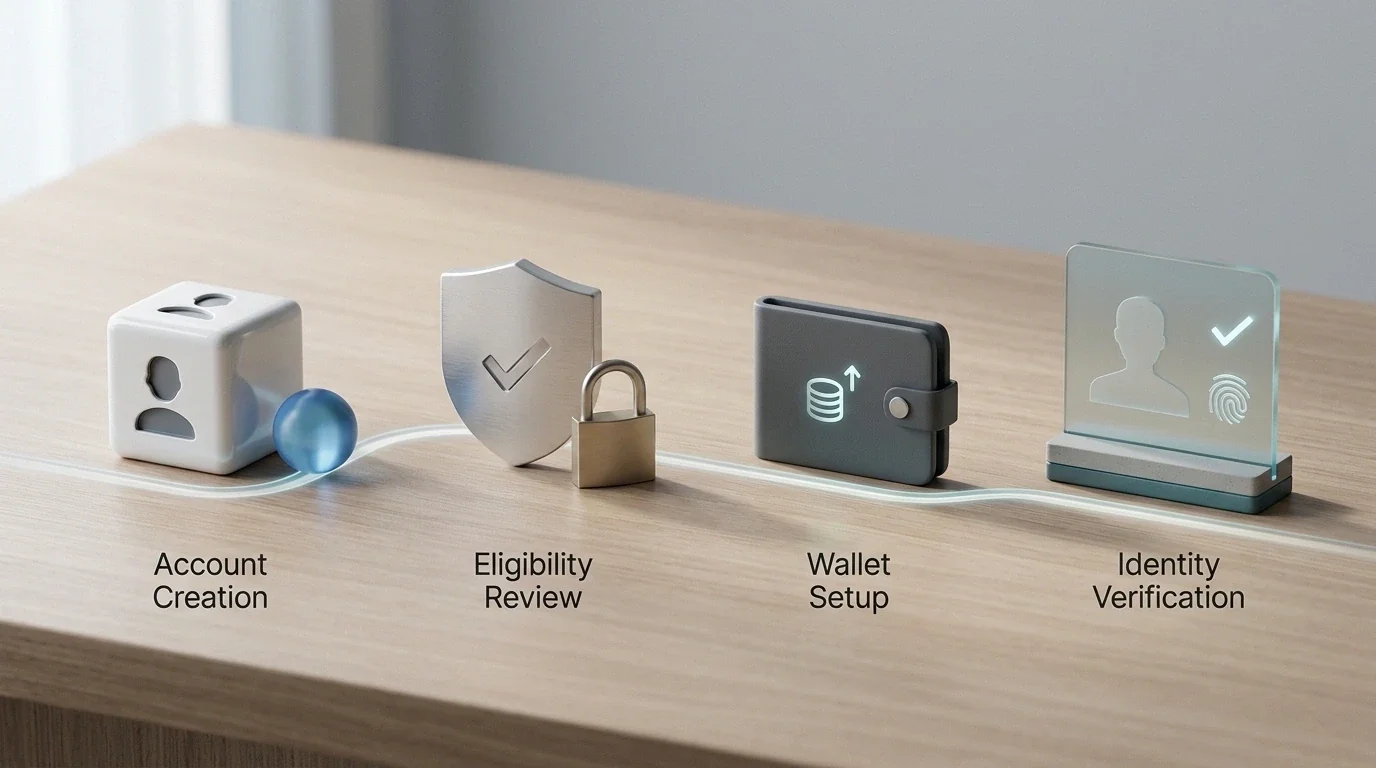
Verification is one condition that can sit between an account balance and a withdrawal request. A specialist review reports that casinos may ask for identity checks before approving a first withdrawal. The requested material can include a photo of an identity document and proof of address; some sites may also ask for a selfie showing the identity document. These requirements are not merely account-opening formalities if they are applied at the point funds are requested.
The practical issue is whether the documents required are clear and whether the account details match them. A name or address discrepancy can leave a request unresolved while the operator seeks further information. The review should therefore cover the verification clause alongside the offer terms, including what documents may be requested and when approval is conditional on their submission. A bonus that appears available in the account is not the same as money already released for payment.
Withdrawal conditions also need to be read independently of the signup headline. The terms should make clear which balance is eligible for withdrawal and whether an offer changes the process. If that distinction is unclear, the displayed figure cannot safely be treated as the amount payable. No advertised bonus can remove the need to satisfy identity checks or the account’s stated withdrawal rules.

BetStop is an Australian service, but it does not bind offshore casinos; it applies only to Australian-licensed operators. Since there are no Australian-licensed online casinos, it should not be treated as a control over offshore accounts. The relevant decision is not whether the offer sounds generous, but whether its conditions and verification demands are explicit—and whether the service can provide Australian legal protection.
Mobile Access and Account Safeguards
Mobile access is a matter of whether an account can be used on a phone, not a measure of the service behind it. A site may present a mobile page or an app, but neither format establishes that play is safe, fair or subject to Australian oversight. The distinction matters when comparing claims about the best Australian pokies app: the label describes a way to access an account, not a safeguard or endorsement.
Account controls are more useful to assess than the screen layout. Deposit limits place a ceiling on money added to an account; loss limits restrict losses; session time limits set boundaries around time spent playing; and self-exclusion provides a way to stop access. These are standard responsible-gambling tools, but their presence alone does not show how a particular operator applies them. The terms should make clear what the control covers and how it works.
Sets a ceiling on the amount of money that can be added to an account.
Restricts the total amount of money a player can lose.
Sets boundaries on the amount of time spent playing.
Provides a mechanism to stop all access to the gambling service.
The practical value is in the boundary, not the menu. A deposit limit does not necessarily set a loss limit, and a session limit does not necessarily stop deposits. Each control addresses a different exposure. Treating them as interchangeable can leave a gap: a time cap may contain session length while leaving the amount available to lose untouched.
Mobile screens can make account settings easy to overlook. A safeguard that is difficult to find or understand has little operational value. Controls should be identified in the account terms and settings, with their effect stated plainly. The relevant question is whether the chosen limit constrains the activity it is meant to constrain, not whether the interface looks polished.
Self-exclusion is distinct from a temporary limit because it is intended to restrict access rather than merely cap one aspect of play. BetStop applies only to Australian-licensed operators and does not bind offshore sites. Since there is no Australian-licensed online casino, BetStop should not be treated as a block on offshore pokies accounts.
A mobile app or browser view cannot change that limitation. Nor does access from a phone make an offshore account subject to Australian account safeguards. The useful distinction is between access technology and account controls: one displays the service; the other may set boundaries on deposits, losses, time or access. Those boundaries need to be assessed individually, without treating a mobile format as evidence that they are effective.

Online Casino Terms and the Land-Based Machine Context
Rules for pokies in a physical venue do not establish that an online casino serving Australian residents is authorised. The settings are separate: venue requirements concern the operation of gaming machines on site, while online casino claims concern a different regulatory context. A reference to an Australian venue, its machines or its staff is not evidence that an online service is licensed in Australia.
A report by regionriverina.com.au says that, from 1 July, venues operating more than 20 gaming machines must have a dedicated responsible gambling officer (RGO) on duty whenever those machines are running. The threshold is tied to the number of machines at the venue, and the duty applies during their operation. It is a staffing requirement, not a general label that can be applied to every gambling service.
The same report describes a one-month grace period for venues to remove signage and bring in responsible gambling officers. That transition period relates to the physical venue requirements; it does not extend to online services or change their status. Signage also has location restrictions: signs directing patrons to gaming lounges must be removed when they are within sight of ATMs or EFTPOS terminals, and signs directing patrons to ATMs must be removed when they are visible from gaming machines. These rules concern what patrons can see around the machines and payment points, rather than how an online account is presented.
Venues are also required to maintain a gambling incident register. It records relevant occurrences, including situations where a patron’s behaviour indicates possible gambling harm or that harm may already be affecting them. The register creates a record of incidents at the venue; it is not a measure of online operators or a safeguard that follows a player between services.
Venue Requirements
Physical venues with more than 20 gaming machines must employ a dedicated responsible gambling officer (RGO) and maintain a gambling incident register.
The practical distinction is straightforward: Australian casino pokies in a venue sit within venue-level operating rules, including RGO coverage, signage controls and incident recording. Similar wording used to describe australian online casino pokies does not import those protections into an online setting. Physical-machine requirements and online service status should therefore be assessed separately, rather than treated as interchangeable evidence.
Trust, Payout Limits and Offshore Redress
Trust is difficult to establish for offshore pokies sites serving Australians. A polished website, published terms or a payment option cannot provide the protection of an Australian legal remedy. If an offshore casino refuses to pay winnings, Australian players have no legal recourse in Australia to compel payment. That makes the operator’s own rules and willingness to honour them central to any assessment—and neither is a substitute for enforceable local rights.
Withdrawal terms also affect the amount and timing of any payment. A specialist casino review reports that some casinos set weekly or monthly withdrawal caps of $5,000–$10,000. On that basis, a $50,000 jackpot could be paid in instalments over a multi-year period, depending on the cap and the operator’s process. The headline balance and the amount available at once are therefore different figures. A cap may be stated in the terms rather than made prominent alongside a large advertised win.

That distinction matters when judging claims that an offshore site is among the best Australian pokies sites or can be considered trusted. Reputation, account access and a displayed balance do not establish that a withdrawal will be paid in full or on a particular schedule. The practical assessment is constrained by the absence of Australian recourse if a dispute arises.
BetStop has a limited reach in this context: it applies to Australian-licensed operators and does not bind offshore sites. As there is no Australian-licensed online casino, a person who has registered with BetStop should not assume that the service will prevent access to an offshore pokies site or block its communications. A safeguard that does not cover a service cannot be treated as protection against that service.
The relevant distinction is between terms that describe a possible payment and a remedy if those terms are not honoured. Offshore withdrawal caps can turn a nominal win into a long payment schedule; refusal to pay leaves no Australian legal route to recover it. Those limits are material to any trust judgement, regardless of how a site presents itself.

New Pokies: What Can Be Verified
A newly released title can attract attention without providing enough information to assess its terms. In a specialist review, providers are reported to offer casinos a choice of return-to-player (RTP) settings for some pokies. As a result, the same game may be configured with different return percentages at different casinos. A title’s name alone, therefore, does not establish which setting applies.
That distinction matters when a site describes a game as new or highlights its return. The provider may make settings available, but the relevant setting is attached to the casino’s version of the game, not guaranteed by the title itself. A general claim about a game’s RTP is incomplete unless it identifies the setting in use.
Claims about new Australian pokies need the same separation between description and evidence. A release label does not verify the game’s identity, its Australian availability, or its quality. Nor does the fact that a provider may offer configurable RTP settings establish which setting a particular casino has selected. Those details should not be inferred from promotional wording.
The narrow substantiated point is that some providers make multiple RTP configurations available for a given pokie, so return percentages may differ between casinos offering the same title. That does not support a ranking of new releases or a verdict on which game is better. Without verified title-specific information, claims about particular new games go beyond what can be established.
Are online pokies legal for Australian players?
Australians are not criminally liable simply for playing on an offshore site that accepts them. However, operators may not provide real-money online pokies to people in Australia without a domestic licence, and no Australian online casino licences have been issued.
How do I know if an online casino is safe to play at?
An offshore casino is not regulated by an Australian online casino licensing system, and an overseas licence does not change that. If it refuses to pay, Australian players have no legal recourse in Australia against it.
Can casinos change the RTP of their games?
Yes. Some game providers let casinos choose from multiple RTP settings, so the same pokie can have different return percentages at different casinos.
Written by the editors at Oscarspin Casino.